The Short Version
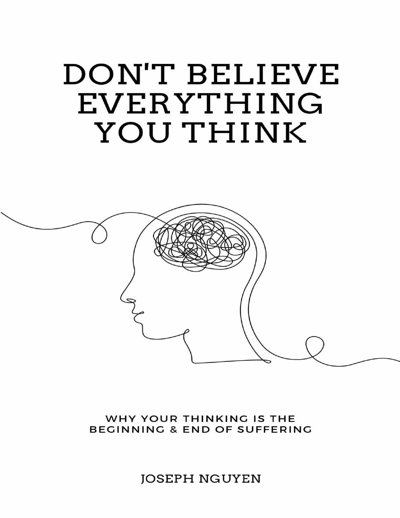
Joseph Nguyen’s Don’t Believe Everything You Think, first published in 2022 with an expanded edition in 2024, is a short self-help book that went viral on TikTok. Its argument is that pain is unavoidable, but suffering comes from thinking about the thoughts that pop into your head. It suits a book club because it has one genuinely useful idea, a spiritual layer that readers will argue about and exercises you can try together.
Below are thirteen discussion questions plus a section on applying the book. The book scores three and a half out of five in our review, with a four and a half for practical tools and a two for depth and evidence.
Before You Start: Content Notes For Your Group
The book is not treatment. Our review warns that if someone in your group lives with serious anxiety, depression, obsessive thoughts, panic attacks, trauma or thoughts of self harm, the book may be frustrating, especially where it implies you can simply stop. Say so before you pick it, and treat it as a small extra, if at all.
Discussion Questions
- Nguyen says a thought is a noun that pops up uninvited, while thinking is the verb of engaging with, judging and arguing with it. Did the split give you a useful picture of overthinking?
- Chapter one uses the Buddhist image of two arrows: the event is the first, your reaction is the second. He says pain is unavoidable but suffering is optional, and he means emotional suffering, not physical pain. Where does that line feel fair, and where does it feel too easy?
- Chapter two says we live in our perception of reality, using two people in the same coffee shop, one spiraling about a career and one happily people watching. Do you agree that we only ever feel what we are thinking?
- The empty boat story has a young monk furious at a boat that bumps his, until he sees it is empty. Our review says real life has fewer truly empty boats than the story suggests. Which view do you take?
- Chapter three says the mind evolved to keep us alive, scanning for danger, so it fixates on what could go wrong. Does that explain your own overthinking?
- The thought experiment asks you to multiply your dream income by five and watch what your mind does. What did you notice when you tried it?
- Chapter five asks you to recall your happiest moment and ask what you were thinking, and often the answer is nothing. Did that match your experience?
- Chapter six credits Sydney Banks and the three principles of Mind, Consciousness and Thought, and describes thoughts as downloads from the Universe, also called Infinite Intelligence, Source or God. Is this inspiring, or a leap from psychology to metaphysics?
- The muddy water jar teaches that trying to fix your thinking is the stirring. Have you ever done less in a spiral and found it helped?
- The introduction says the idea will seem too simple and that your ego will resist. Our review says this files any doubt as a symptom. Is that a clever setup or a way to avoid skepticism?
- The book states that thinking is the root cause of all psychological suffering. Our review notes that emotions also come from sleep, health, hormones, loss and circumstance. Where do you land?
- The introduction mentions coaching clients with a two to five times increase in income, vanished addictions and better health. These are anecdotes, not studies. How much weight should a reader give them?
- Our review calls the repetition a weakness: by chapter ten you can finish his sentences. Is repetition part of how the lesson sticks, or just padding?
Applying It Together
Try the three-step framework from the closing guide as a group. Step one, realize that when you are suffering you are thinking, and do not hunt for a deeper cause. Step two, make space for the feeling. Step three, let it pass without attaching to anything, and if the heavy feeling remains, go back to step one. Run the five-times-income exercise aloud, then share what each person noticed. Ask everyone to try the seven-day experiment of naming the moment they move from a thought to thinking about the thought, and report back. Keep your own judgment about anything the book says about how the universe works.
About The Book
The book has an introduction, seventeen short chapters and a set of guides, with quotes from famous people opening each chapter. It began as a self-published title and has been translated into more than forty languages. Our review notes the original edition has a few proofreading slips, such as misspelled names on the chapter quotes. It is sold as a paperback, ebook and audiobook, and many libraries lend it, which our review calls the safest route.
What To Read Next
If your group wants to decide first, start with our review. Our summary covers every chapter, our lessons page turns the ideas into practical steps, and our books-like-it list covers seven picks including The Power of Now, The Untethered Soul and The Happiness Trap.