The Four Agreements Summary: Each One Tested on Real Days
The Four Agreements summary, one ordinary day per agreement: what Ruiz says, a plain example and the common misreading, plus the fifth agreement as a cited fact. A summary, not advice.

Be impeccable with your word, don't take anything personally, don't make assumptions, always do your best: four rules, one very short book.
Four memorable, kind rules that genuinely help, wrapped in mystical claims and big numbers the book never backs up. Keep the rules, skip the mythology. Three and a half out of five.
Every guide comes as a video and a full written article. Pick the one you need: the review is spoiler-free, the ending explained is not.

The Four Agreements summary, one ordinary day per agreement: what Ruiz says, a plain example and the common misreading, plus the fifth agreement as a cited fact. A summary, not advice.
Is The Four Agreements by don Miguel Ruiz worth reading? An honest, spoiler-free review of the four agreements, how to apply them, what is genuinely useful, what is thin or criticized (the Toltec claims and missing evidence), my score and who it is for.
The Four Agreements (1997) is don Miguel Ruiz’s short guide to personal freedom, built on what he presents as Toltec wisdom. Its core idea is that we all carry beliefs we never chose, and that four new agreements can replace them: be impeccable with your word, don’t take anything personally, don’t make assumptions, and always do your best. It has reportedly sold millions of copies in the United States, with a publisher figure above eight million (as of October 2026).
Below you’ll find a spoiler-free review that walks through each agreement, what is genuinely useful, what is thin, and the fair criticisms of its Toltec and scientific claims.
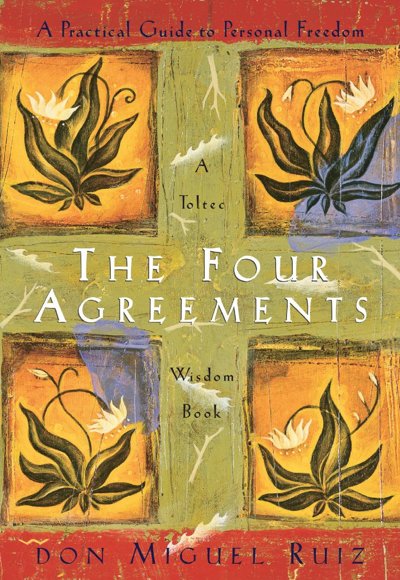
The Four Agreements came out in nineteen ninety seven, with the subtitle A Practical Guide to Personal Freedom. It's short enough to finish in one sitting, and I went through all of it, from the opening chapter on domestication to the prayers at the very end.
Ruiz presents it as Toltec wisdom, passed down through his family. His core idea is simple. From the day we're born, we sign up for beliefs we never chose. He calls those beliefs agreements, and he says they quietly run our lives. The book offers four new agreements to replace the old ones.
It even opens with a short legend, The Smokey Mirror, about a man who realizes everything is made of light. It sets a mystical tone, and you'll know quickly whether that's your thing.
The Four Agreements came out in nineteen ninety seven, with the subtitle A Practical Guide to Personal Freedom. It's short enough to finish in one sitting, and I went through all of it, from the opening chapter on domestication to the prayers at the very end.
Four memorable, kind rules that genuinely help, wrapped in mystical claims and big numbers the book never backs up. Keep the rules, skip the mythology. Three and a half out of five. Read it if: you want a short, friendly start in self-help; you overthink what other people say about you; you like one simple framework you can remember. Skip it if: you want evidence-based psychology; spiritual language puts you off. Review: The Four Agreements →
The Four Agreements summary, one ordinary day per agreement: what Ruiz says, a plain example and the common misreading, plus the fifth agreement as a cited fact. A summary, not advice. Summary: The Four Agreements →
The Power of Now by Eckhart Tolle, The Untethered Soul by Michael A. Singer, Meditations by Marcus Aurelius, The Fifth Agreement by Don Miguel Ruiz and Don Jose Ruiz.
Be impeccable with your word, don't take anything personally, don't make assumptions, and always do your best. Ruiz presents them as replacements for the fear-based beliefs we absorb as children.
The book first came out in 1997 from Amber-Allen Publishing, with the subtitle A Practical Guide to Personal Freedom.
Figures vary by source. Publishers Weekly has reported millions of US copies, and the publisher's later marketing copy claims more than eight million in the United States (as of October 2026).
Historians treat the Toltec as a partly legendary culture, and an academic study argues that modern Toltec spirituality has drifted from the archaeological one. Ruiz presents it as a family tradition, not as history (as of October 2026).
Amazon links. We may earn a commission if you buy through them.