The Calendar
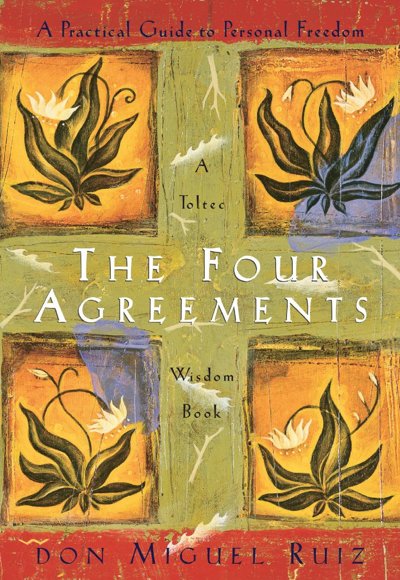
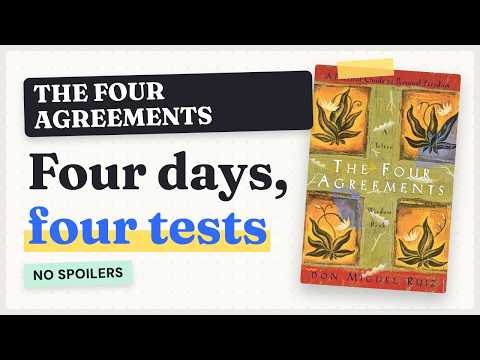
Here is the plan. The Four Agreements, by don Miguel Ruiz, is a short book with four rules. Instead of reading them back in order, I will give each rule one ordinary day and see whether it survives. For every agreement you get three things: what Ruiz says, a plain example, and the way people most often misread it.
My short answer, and it is only my opinion, is that Monday and Wednesday hold up best, Tuesday needs a warning label, and Thursday is the rule that makes the other three bearable. This is a book summary, not advice. There are no spoilers here, because it is a guide and not a story.
The Setup
The book came out in nineteen ninety-seven from Amber-Allen Publishing, with the subtitle A Practical Guide to Personal Freedom. Ruiz presents it as Toltec wisdom. Before he gives you a single rule, he spends a whole chapter on why you would need one.
His claim is that as children we were trained like animals, with punishment and reward, until we took on a rulebook he calls the Book of Law. Inside us, he says, a Judge reads that rulebook and a Victim takes the blame. Every belief we agreed to without choosing it is what he calls an agreement.
Then comes the pitch. Four new agreements, he says, can replace the old ones. I counted the words in my copy. The four agreement chapters run three thousand eight hundred thirty-eight, two thousand five hundred forty-one, two thousand forty-three and three thousand words. That is about eleven thousand four hundred, a little over half of the main text.
Monday: Your Word
Monday, nine in the morning. A colleague asks what you think of the new hire, and you have an opinion that is not very kind. These test days are my own made up examples, not the book’s.
The first agreement is to be impeccable with your word. Ruiz says impeccable means without sin, and he defines sin in one short line: “A sin is anything that you do which goes against yourself.” So impeccable speech is speech that does not work against you.
His own example is gossip, which he compares to a computer virus. Before a new class, someone tells you the teacher is a pompous jerk. You carry that into the room, you start to hate the class, and you drop out. Ruiz says you blame the teacher, but gossip is to blame.
So what does the agreement change at nine o’clock? You do not have to invent praise. You can say that you barely know the person, or that you would rather not judge them yet. Ruiz also says the truth is what breaks the spells that careless words cast, so honesty is not the enemy here, only the cruelty and the guessing.
In that chapter, my count finds the word impeccable or impeccability thirty-one times. Here is the misreading. Many people hear polite and perfect. Ruiz means something else: take responsibility for what you do, but do not judge or blame yourself. A big share of the chapter is about the things we say to ourselves. In my view Monday passes, but only if you count the voice in your own head.
Tuesday: Not Personal
Tuesday, noon. A message arrives, short and cold, and no greeting. By one o’clock you have written three replies in your head and sent none of them.
The second agreement is to not take anything personally. Ruiz writes, “Nothing other people do is because of you.” His reasoning is that everyone lives in a private dream. What they say comes from their own beliefs and fears, so even praise is not really about you.
He pictures your life as a movie, where you are the director, the producer and the main actor, and everyone else has a smaller part. When someone else lashes out, he says, they are the star of a different movie. Taking it personally, he writes, is the maximum expression of selfishness.
Here is how the cold message plays out under this rule. You still might ask the sender if something is wrong. You just do not decide in advance that you did something. In Ruiz’s words, if you take it personally, you agree with it, and then the poison goes through you. That is his image, and I find it vivid.
The word personally appears thirty-five times in that chapter by my count. Now the misreading. Some readers hear that they must put up with anything. The book says the opposite on one point: if someone does not treat you with love and respect, Ruiz says it is a gift if they walk away. Still, he goes as far as saying that even a gunshot is nothing personal. In my opinion that is where I stop following him. Tuesday passes with a warning label.
Wednesday: No Assumptions
Wednesday, six in the evening. Your partner comes home quiet, and you decide you know exactly why. You say nothing, and you wait.
The third agreement is to not make assumptions. Ruiz writes, “It is always better to ask questions than to make an assumption.” One of his examples is a couple. The wife is upset, the husband has no idea why, and she thinks he should have known, as if he could read her mind.
He adds a bigger version. We assume everyone sees life the way we do, that they judge the way we judge and think the way we think. He says that is the biggest assumption humans make. It is also why we are afraid to be ourselves around other people.
Under this rule the evening goes differently. You say, you seem quiet, did something happen? Then you listen to the answer. Ruiz also tells you to find your voice and ask for what you want, because we often expect people to know what we want without saying it, and that is where the hurt begins.
The words assume, assumption and assumptions appear fifty-eight times in this short chapter. The misreading is to turn the agreement into an interrogation. Ruiz says everybody has the right to say no, and you always have the right to ask. He also says that even after you get an answer, you should not assume you know everything. My view is that Wednesday is the cleanest pass of the four.
Thursday: Your Best
Thursday, ten at night. You are tired, the dishes are in the sink, and the report you wanted to finish is half done.
The fourth agreement is to always do your best. Ruiz writes, “no more and no less.” He is careful to say that your best is not a fixed number. It is better when you are rested than when you are tired, better when you are healthy than when you are sick, and it changes with your mood.
He says that if you push beyond your best, you drain yourself and it takes longer. If you do less, you pay in guilt and regret. He calls this agreement the one that lets the other three become habits, and he says you should not expect to keep them perfectly. If you break one, begin again tomorrow.
Under this rule, Thursday looks modest. You finish what a tired person can honestly finish, close the laptop, and tell the Judge, in the book’s own words, that you did your best. There is nothing left for it to argue with. That is the entire trick, and it is a kind one.
The phrase your best appears fifty times in that chapter. The first misreading is that this means grind harder, and the book says no more than your best. The second is that it is a loophole. Ruiz asks you to practice, look honestly at the results, and keep practicing. I would call this the rule that holds the week together.
Friday: The Day Left Over
There is no fifth day in this book, so Friday is where I keep one outside fact, as a cited fact only, as of October twenty twenty-six.
Ruiz later wrote a book called The Fifth Agreement, with his son, don Jose Ruiz. Our copy lists it in the back pages, so it exists, but I have not read it. Ruiz’s own website gives the fifth agreement as: be skeptical, but learn to listen. The Omega Institute article on the same book words it the same way.
The same website carries a copyright date of twenty ten for the book. Note that the publisher blurb in our copy describes the fifth agreement in different words, about seeing the truth and recovering authenticity. So I am not going to explain it any further. That is the whole of what I can say with confidence.
The Scoreboard
Here is my scoreboard for how each rule survived its day. These are opinion scores, and you can argue with me. Monday, your word, four out of five. Tuesday, not personal, three. Wednesday, no assumptions, four. Thursday, your best, four and a half. That averages to about three point nine.
Now the honest limits. The book states numbers with no source, like the claim in the first chapter that ninety-five percent of our beliefs are lies. Its last chapters turn mystical, with a parasite in the mind and a symbolic death.
It also says you suffer only because you choose to. That is a hard line for anyone dealing with depression or trauma, and this video is not a replacement for a therapist. If you want my full verdict, the review is its own video.
Your Turn
That is the whole week. Tell me in the comments: which day would you have failed, Monday, Tuesday, Wednesday or Thursday?
If you want more book summaries, subscribe, and tap like. The full guide is at book explained dot com.