The Short Version
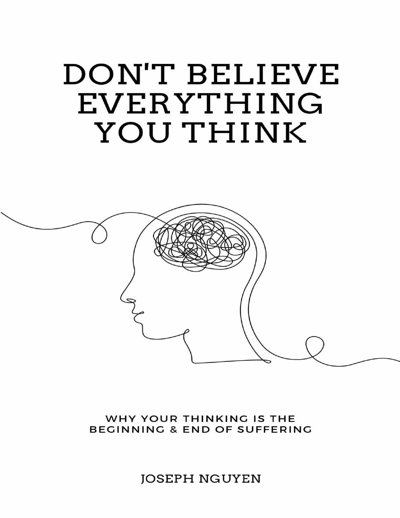
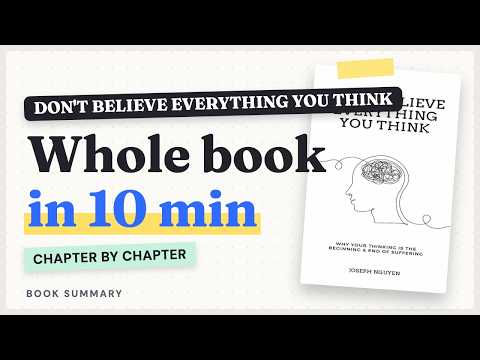
Today it’s the Don’t Believe Everything You Think summary, chapter by chapter, in about ten minutes. This video is spoiler free, which for a self help book just means I’m not going to hide the main idea from you.
Here it is. Joseph Nguyen says the pain in your life is mostly unavoidable, but the suffering on top of it comes from thinking about your thoughts. Thoughts just show up. Thinking is what you do next. His fix is to notice it and let it settle. That’s the whole book, and I’ll show you how he builds it.
Who Is Joseph Nguyen
First, who wrote it. Joseph Nguyen is an author and coach. The book came out in twenty twenty-two as a short, self published title, and it took off after videos of him reading from it went viral on TikTok. It has since been translated into more than forty languages.
An expanded edition came out in October twenty twenty-four, and publishers now describe it as a New York Times bestseller. I read the original twenty twenty-two text, so if you own the expanded one, your chapters may differ a little. He has also written follow ups, including one about overthinking and decisions.
How the Book Wants to Be Read
The introduction sets the tone, and it’s big. He promises that you will not be the same person after reading, and that anyone can find peace and fulfillment. He also says not to read for information but for insight, and to look for a feeling rather than memorize sentences.
He warns that the idea will seem too simple, and that your ego will try to make it complicated. That is a clever setup, because it makes any doubt part of the lesson. Keep that in mind as you read, and hold the promises loosely.
Pain Is Not Suffering
Chapter one is his own story. He tried therapy, books, retreats, early mornings, diets and daily meditation, and he still felt anxious and heavy every day. Then a mentor taught him how the mind works, and that changed things for him. He keeps the details light.
The key move comes from an old Buddhist teaching. When something bad happens, two arrows fly. The first is the event, and you can’t always dodge it. The second is your reaction. He says pain is unavoidable, but suffering is optional, and he means emotional suffering, not physical pain.
We Live in a World of Thought
Chapter two gives the core claim. We don’t live in reality, he says, we live in our perception of it. Picture two people in the same coffee shop. One is spiraling about their career, the other is happily people watching. Same room, same coffee, completely different experience.
He backs it up with questions. Ask a hundred people what money means and you get a hundred answers. Ask what they think of the president, same thing. Two people can do the same job, one loves it and one hates it. His conclusion is bold: we only ever feel what we’re thinking.
The Empty Boat
Chapter two ends with a Zen story that many people remember. A young monk is angry because noise keeps disturbing his meditation, so he rows to the middle of a lake for peace. Then a boat bumps into his, and he’s furious, until he sees it’s empty.
The point is that nobody was there to blame. The anger came from his own reaction. Nguyen says the people and situations that upset us are all empty boats. The idea is useful, even if real life has fewer truly empty boats than the story suggests.
Why We Think
Chapter three is short. He says the mind evolved to keep us alive. It scans for danger and uses old memories to predict future threats, which is why it fixates on what could go wrong. He says that’s innocent, it’s just doing its job.
The problem, he argues, is that we no longer live where danger hides in every bush, so a mind built for survival keeps us in fight or flight over emails and awkward texts. It protects us but doesn’t help us feel fulfilled. That’s the setup for chapter four, which is the real engine of the book.
Thoughts Versus Thinking
Here’s the distinction that gives the book its title. A thought, he says, is a noun. It pops up uninvited, takes no effort, and you can’t control it. Thinking is the verb: engaging with the thought, judging it, arguing with it. His slogan is that thoughts create and thinking destroys.
He proves it with an exercise. Name the income you’d love, then multiply it by five and notice what happens. The first number appears easily. Then comes the spiral about greed and doubt. He adds a chart: thoughts feel light, thinking feels heavy, and your feelings work like a dashboard telling you which is happening.
Do You Have to Think Positive
Chapter five answers the obvious question. If we feel what we think, must we think positive? He says no. Recall the happiest moment of your life and ask what you were thinking. Often the answer is nothing, or the gratitude thought came after the feeling.
So joy doesn’t need a thought, he says. It is our natural state, like a baby’s. The stress we feel, he claims, is proportional to how much we’re thinking, not what we’re thinking about. His coach’s picture is a thought-o-meter, like a speedometer. Notice that this is his claim from experience, not something he tests.
The Three Principles
Chapter six is where the spiritual framework appears. He credits Sydney Banks, who taught what are called the three principles: Universal Mind, Consciousness and Thought. Mind is the life force behind everything, consciousness is our awareness, and thought is the raw material we experience.
He uses a movie analogy. Thought is the disc, consciousness is the player and screen, and mind is the electricity. He says thoughts come from that universal source, so some readers will find this the most inspiring chapter and others will find it the point where the book leaves evidence behind. I’ll come back to that.
How to Stop Thinking
Chapter seven answers the practical question, and the answer is almost anticlimactic. You can’t fully stop thinking, he says, and you shouldn’t try. You just become aware that you’re thinking, and that awareness lets it settle on its own.
He gives three images. A bowl of muddy water clears if you leave it still. Quicksand pulls you under faster if you struggle. And the sun is always there at night, even when you can’t see it. He also adds a samurai story, where seeing your own rage is the moment hell turns into heaven.
Flow, Goals and Love
Chapters eight to ten cover living a real life. Our best work happens in flow, he says, when we lose track of time, and athletes call that the zone. He mentions the Japanese idea of mushin, a mind without ego or fear.
Then goals. He splits them in two. Goals from desperation feel heavy and urgent, and they are always a means to something else. Goals from inspiration feel light, and you pursue them just because you want to. He ends with unconditional love, using his girlfriend, who couldn’t give reasons for loving him.
After Peace, Intuition and Obstacles
Chapters eleven to sixteen deal with what comes next. After you feel calm, doubt can creep in, because the ego wants control back. He uses a rope mistaken for a snake as the example. Chapter twelve says nothing is good or bad, like no wrong keys on a piano.
Chapters thirteen and fourteen say to trust your gut instead of polling everyone. Chapter fifteen is about making space, with stories of Edison napping and Einstein playing violin. Chapter sixteen warns that feeling peaceful can feel suspicious, so don’t mistake calm for laziness.
The Guides at the End
The back of the book is practical. There’s a three step framework: realize thinking is the cause, give the feeling space without fighting it, then let it pass. There’s an audit of what triggers your thinking, a morning ritual, a work energy list, and a long set of questions for breaking habits.
Those pages are the most usable part of the book. Several are simple, like rating how much you thought today from one to ten, and listing what drains you at work. He suggests removing one to three draining tasks a week, with a goal of spending most of your work time on what energizes you.
Another exercise asks about the phone and the media you consume, since those can keep you in a stressed state. It is basic, sensible advice, and I cover how to use it in my practical plan video, which is linked.
What Holds Up and What Doesn’t
Before my verdict, a fair word on the science. The book is a spiritual teaching, not a research report, so its big claims are the author’s claims. Studies on rumination, going over the same worries again and again, do link it with anxiety and depression. That supports his suspicion of overthinking.
But the claim that every negative feeling comes only from thinking is not established. Emotions also come from the body, sleep, health, trauma and real circumstances. His reported results, like clients doubling or quintupling their income, are anecdotes. Treat the book as a mindset tool, and the cosmic parts as his belief.
My Take in One Minute
So is it worth reading? It’s short, warm and repetitive on purpose. The strongest idea, that you can watch a thought without obeying it, is old and genuinely helpful, and close to a technique therapists call cognitive defusion. The weakest part is the claim that thinking is the root of all suffering, which is a belief, not a proven fact.
The book also isn’t therapy, and it isn’t a substitute for it. If your anxiety is severe, please talk to a professional. I’d keep the tools and leave the cosmic bits if they don’t fit. Which chapter hit you hardest? Tell me in the comments, and subscribe for more book breakdowns.