Welcome and the Big Idea
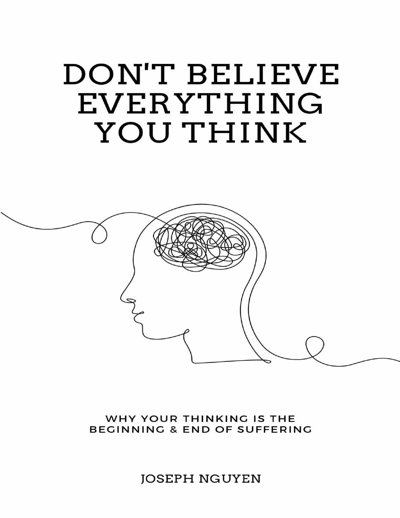
This is the complete guide to Don’t Believe Everything You Think by Joseph Nguyen: every chapter, every example and exercise, retold in my own words, with my honest take along the way. It isn’t an audiobook, and I won’t read the book to you.
Quick spoiler note. For a self help book, spoilers just mean I’ll explain the whole argument, including the ending exercises. If you’d rather go in fresh, watch my short summary instead. The central idea, in one breath, is that pain is unavoidable but suffering comes from thinking about your thoughts, and that you can let that thinking settle by simply noticing it.
I’ll walk through the introduction, all seventeen chapters, and the guides at the end, then check what holds up and what doesn’t. Use the chapter markers to jump around. And one reminder: this is a book discussion, not medical advice.
The Author and the Book
Joseph Nguyen is an author and coach. He first published this book in twenty twenty-two as an independent release, and videos of him reading from it spread widely on TikTok. It has since been translated into more than forty languages, and the expanded edition from October twenty twenty-four is described by publishers as a New York Times bestseller.
I’m working from the original twenty twenty-two text, which has an introduction, seventeen chapters and a set of guides. The expanded edition has added material, so some details may differ. Nguyen has since written other books, including beyond thoughts, Boundaries Equals Freedom, The Art of Creating, and The Overthinker’s Guide to Making Decisions.
The ideas come from a teaching tradition. In the acknowledgments, he thanks Sydney Banks, who taught what are called the three principles, and two teachers who shared them with him. He also dedicates the book to his girlfriend, Kenna, whom we’ll meet in chapter ten.
The Introduction: Big Promises
The introduction is a pep talk with big promises. He says the book will help you find everything you’ve been searching for, and that you won’t be the same person after reading. He claims anyone, whatever their background, can find peace, love and fulfillment, and he even says you’re not the exception.
He then lists results his coaching clients have reported, like higher income, better relationships, fewer destructive habits and more energy. He admits he’s reluctant to mention them, since the real point is the feelings. His argument: we want money and status because we want to feel love, joy and peace, but we mistakenly think things give us those feelings.
Then come his reading instructions. Read for insight, not information. The words point to the truth but are not the truth. Look for a feeling, not an argument. And if it seems too simple, that’s your ego trying to complicate things. I’ll flag that last bit again later, because it’s a big part of how the book works.
Chapter One: The Journey to the Root Cause
Chapter one is short and personal. It opens with a quote from the Buddhist teacher Thich Nhat Hanh, about people preferring familiar suffering over the unknown. Nguyen then clarifies that by suffering, he means psychological and emotional suffering. He says he isn’t claiming it’s all in your head, because terrible events happen.
Then the Buddhist two arrows idea. The first arrow is the event. The second is your reaction, and the teaching is that it’s optional. Nguyen says that when he first heard this, he didn’t know how to apply it. If choosing not to suffer were easy, nobody would suffer.
So he describes his search. He read hundreds of books, studied psychology, saw therapists, woke at four in the morning, changed his diet, did shadow work, meditated daily, went on retreats and followed spiritual teachers. Some things helped a little, but he still felt anxious, angry and heavy every day. In his darkest hour, a mentor taught him how the mind works, and that’s what the book passes on.
Chapter Two: We Live in a World of Thought
Chapter two begins with the claim that we live in a world of thought, not reality. The coffee shop example is the classic one. Two people sit in the same shop. One is stressed about their life and comparing themselves to everyone. The other is enjoying a drink and watching people. Same place, different worlds.
He gives more examples. Ask a hundred people what money means, and you’ll get close to a hundred answers: freedom, security, greed, evil. Ask what they think of the current president, and again the answers differ for the same man. The event or thing is neutral, he says, and the meaning is added by us.
Then the job example. Imagine you hate your job, and while sitting on the couch with your family, your thoughts about work make you furious. The room didn’t change, only your thinking. And two people in the same job can have opposite experiences. From this, he concludes that our feelings come from our thinking about events, not from the events, so we can only ever feel what we’re thinking.
Who Would You Be Without That Thought
Next is a thought experiment. Take the thought that you hate your job, and ask yourself who you’d be without it. Give it a minute. He predicts you’ll feel lighter, happier and freer. Without the usual thinking about something, your experience of it changes.
From that he draws the central claim of the book: the root cause of our suffering is our own thinking. He anticipates your pushback, joking that you might want to throw the book across the room. He insists he isn’t saying your feelings are fake. Our perception is real, and we do feel what we think.
The hopeful part, as he frames it, is that if feelings come from thinking, we are only one thought away from a different experience. In his words, the moment we stop thinking is when our happiness begins. That’s a big leap, and I’ll question it later. But note how he builds it from very ordinary examples first.
The Empty Boat
Chapter two ends with the Zen story of the young monk and the empty boat, and it’s the first of the book’s parables. A young monk keeps getting angry in meditation because of noises: people moving, animals, wind, birds. His mentor asks whether he knows what is really making him angry.
He tries to escape the noise, first on the lake shore, then by rowing out to the middle of the lake. For a few days it works. Then one day a boat bumps into his, and he shouts and screams at the other pilot. Standing up, he discovers the boat is empty. It drifted there on the breeze.
His anger vanishes, and he realizes that it was never the boat or the noise but his reaction. Returning to the monastery, he treats disturbances as empty boats. Nguyen’s lesson is that people and situations that upset us have no power without our reaction. It’s a nice story, though I’d say some boats do have someone in them.
Chapter Three: Why Do We Even Think
Chapter three is the shortest in the book, and it explains why the mind behaves this way. His answer is evolution. Humans developed the ability to analyze and rationalize because it helped us survive. The mind scans for danger, and it even uses old memories to imagine future threats.
He says none of that is wrong. The mind is doing its job, and conflict with it comes from an innocent misunderstanding. The mind’s duty is to keep us alive, while consciousness, or the soul, is about fulfillment. The mind helps us survive, not thrive.
The trouble is that we’re no longer in the wild, where danger could be in a bush. If we keep running on the survival mind, he says, we stay in fight or flight, with anxiety, fear, anger and resentment, because everything gets treated as a threat. His fix is not to attack the mind but to relieve it of duty and tune in to something greater. This is where the spiritual language begins to arrive.
I’ll note a small point of honesty here. The idea that the mind is wired to notice threats is widely discussed in psychology, and it’s a useful way to be kinder to yourself. The idea that you can switch off that system by deciding to is more optimistic than most researchers would be.
Chapter Four: Thoughts Versus Thinking
Chapter four is the heart of the book, and it is the source of its title. Thoughts, he says, are the raw material for everything we create. They are nouns, something we have, and not something we do. They require no effort, we can’t control which ones arrive, and he says they come from beyond the mind, from the Universe.
Thinking is the verb. It’s the act of thinking about our thoughts, engaging, judging and analyzing. That takes energy and willpower, which he calls a finite resource. You don’t have to engage with every thought, but when you do, that’s thinking. He states plainly that thinking is the root cause of all our psychological suffering.
Then comes the income experiment. First, name your dream yearly income. A number pops up in seconds, effortless and probably exciting. That’s a thought. Now multiply it by five, and think about it for a minute. Most people go on a rollercoaster: I can’t do that, nobody in my family makes that, it’s greedy.
His takeaway is that the first number didn’t hurt. The thinking afterward did. The same happens if you ask how you might earn it. Ideas pop up, which he calls thoughts of creation, and then thinking arrives with limits and doubts. Hence the slogan: thoughts create, and thinking destroys.
The Chart and the Feelings Dashboard
Nguyen then offers a way to tell the two apart. He says to use your feelings as an internal radar. If you feel lighter, alive and expansive, you’re receiving thoughts. If you feel heavy, restricted and stressed, you’re probably thinking about your thoughts. Negative emotions become a signal that you’re thinking too much.
The chapter ends with a comparison chart. Thoughts come from the Universe, feel light and expansive, are infinite and creative, and carry positive charge. Thinking comes from the ego, feels heavy and restrictive, is limited and destructive, and carries negative charge. Thoughts feel effortless and alive, while thinking is laborious and stressful.
Chart aside, the practical value is the signal. Heaviness is a cue to pause. My caution is that the chart presents a neat split, whereas real thinking is sometimes useful. Planning, problem solving and checking a risky decision all involve thinking about your thoughts. The book mostly treats that as a problem, with an exception for survival danger that it mentions in chapter five.
Chapter Five: Do You Have to Think Positive
Chapter five asks the obvious question. If we feel what we think, must we think positive to feel good? He first adds a caveat: more accurately, we feel negative emotions when we think. Some negative emotions are useful for survival, like fear in a dark alley, but he says most of the time they are unhelpful.
Then another experiment. Recall the time you felt the most joy and love of your life, and ask what thoughts were in your head at that peak. Many people realize there were none. Others say they thought they were grateful, but the feeling came before the thought. So positive feelings don’t need thoughts.
From there he says our natural state is joy, love and peace, and he uses a baby as the example of a mind not yet conditioned. Stress shows up when we think. The strength of negative emotion, he says, is in direct proportion to the amount of thinking, and positive emotion grows as thinking shrinks.
His coach’s image is a thought-o-meter, a speedometer for thoughts per minute, and the red zone means burnout and anger. His conclusion: it’s not what we think about but that we’re thinking. This chapter is persuasive as personal experience, though it’s not tested science. Calm and joy can also come with plenty of thinking, in conversation or play.
Chapter Six: The Three Principles
Chapter six lays out the framework behind everything. Human experience, he says, is made by three principles: Universal Mind, Consciousness and Thought. All three must be present for us to experience anything. He credits their discovery to Sydney Banks, and says understanding them is how we can relieve suffering and create from Source.
Universal Mind is the intelligence behind all life, the force that tells an acorn to grow into a tree and keeps planets in orbit. People call it God, Infinite Intelligence, the Quantum Field or Source. Everything is connected by it, and separation is an illusion of thinking. Connection to it feels like love, joy and inspiration.
Universal Consciousness is our awareness, the thing that lets us notice that we exist and notice our thoughts. Universal Thought is the raw material we perceive and create from. He compares it to a movie setup: thought is the disc, consciousness is the player and screen, and mind is the electricity that powers it.
This is where reading gets personal. If you find the framework meaningful, it can make the rest of the book feel coherent. If not, you can set it aside and keep the practical parts. I’d just remember that these are spiritual claims, not findings, and that I couldn’t find strong independent trials for the approach.
Chapter Seven: How to Stop Thinking
Chapter seven opens with the samurai parable. An angry samurai demands that a Zen master explain heaven and hell. The master insults him until the samurai draws his sword to kill him. The master calmly says, that’s hell. The samurai freezes, understands, bows in gratitude, and the master says, and that’s heaven.
Then he answers the title question. You can’t entirely stop thinking, but you can spend less time in it. You aren’t trying to stop thoughts, only to let them flow through while you reduce thinking about them. And the paradox is that you don’t have to do anything except become aware of it.
His mentor’s analogy is a bowl of muddy water. Filtering or boiling won’t help as much as leaving it alone, and soon the dirt settles. The mind is the same. Quicksand is the second image: the more you fight, the worse it gets, and relaxing lets you float. The third is the sun at night. It’s always there, even when you can’t see it.
He adds that bouncing between thinking and calm is normal, and trying to stay in non-thinking all day would itself cause suffering. We can forget our natural state but never lose it. And remembering is enough to start coming home. It’s a gentle chapter and, to me, one of the most useful.
Chapter Eight: Flow and the Zone
Chapter eight asks how we can thrive without thinking. It opens with a Clear line about anxiety being thought without control and flow being control without thought. Then two questions. What thoughts go through your head when you do your best work? And what are you thinking when you lose track of time?
His claim is that during flow you aren’t thinking, or the thoughts just pass through. Peak performance, he says, is non-thinking. As a second example, he points to athletes, asking if Olympic competitors are overanalyzing mid game. They describe being in the zone.
He brings in the Japanese word mushin, defined in a karate source as a mind free of random thoughts, anger, fear and ego, where the practitioner reacts from trained instinct. After practice, he argues, thinking only hinders performance. Doubt, hesitation and insecurity appear when we overanalyze.
This one rings true to many people, and research on flow describes deep absorption and less self-consciousness. But skilled performance depends on lots of earlier deliberate practice and thinking, as the karate quote itself says. Non-thinking is the result of training, not a replacement for it. Nguyen invites you to try it rather than adopt the belief.
Chapter Nine: Goals, Dreams and Ambitions
Chapter nine tackles a worry: if I stop thinking, do I lose my ambition? Nguyen admits he panicked about this, fearing he’d have to become a monk or a couch potato. His answer is that goals aren’t good or bad. What matters is where they come from, and there are two sources: inspiration and desperation.
Goals from desperation feel heavy, urgent and scarce. You feel imposter syndrome and never enough time. Even after achieving them, the emptiness returns, so you set a bigger goal. They are usually means goals, pursued for something else, like making a million to be free or quitting a job to escape stress. They feel like you have to, not want to.
Goals from inspiration feel light, expansive and exciting. They’re like a calling, which is why painters paint and singers sing even if they never get paid. They are ends in themselves, and you create from wholeness, not to become whole. He calls this divine inspiration, and says it doesn’t depend on past data or what’s realistic.
To tell them apart, he says, ask if the goal came as a thought or as thinking, and notice if it feels heavy or light. He compares our natural flow of inspiration to a river, and thinking to a dam that harms the whole ecosystem. His test question: if you had infinite money, had traveled the world, had no fear and got no recognition, what would you do?
Chapter Ten: Unconditional Love and Creation
Chapter ten starts with a story about his girlfriend, whom he calls Makenna, elsewhere Kenna. A year into dating, he asked why she loved him. She said she didn’t know, she just did. When she asked him the same, he listed dozens of reasons. Years later, she still says the same thing, and it bothered him.
Then a realization. If he loves her because of her laugh or her kindness, his love depends on those traits, and it would end if they disappeared. Reasons make love conditional. She couldn’t list reasons because her love was unconditional. He then made his own love unconditional by dropping the reasons.
He extends this to creation. Most creating is conditional: you make money to get security, or work for fame. It becomes a chase, and the satisfaction lasts seconds. What we really want are feelings, and feelings can only come from within us, not from external things.
Unconditional creation, by contrast, is making something just because you want to. Then you feel the love and joy immediately, since you’re creating from abundance. He says it needs non-thinking, because the thinking mind insists that doing something for no reason is pointless. This is a lovely idea, though real life also needs paying bills.
Chapter Eleven: What Comes After Peace
Chapter eleven predicts what happens once you’ve tasted peace. You might feel worry, anxiety and doubt, wondering if you’ve lost your edge and drive. Nguyen says this is normal and part of awakening. He calls it the death of the personal ego, which then tries to reclaim control.
He gives the snake and rope example. You’re on a trail and almost step on a venomous snake. You freak out, then realize it’s a rope, and you resume your walk. You can’t prevent the first reaction, but you can remember that your thinking created the fear. The goal is not to stop thinking, but to shorten the time it takes to remember.
Another reason for post-peace doubt is leftover energy. When you stop spending huge energy on thinking, it’s freed up, and old habits send it back to overthinking. His fix is to channel it into inspired goals, which is why you should set them first. Pointing it at desperate goals just continues the stress.
He also recommends an activation ritual, a morning routine that gets you into a non-thinking state and builds momentum. He says he used to wonder why spiritual leaders keep morning routines. It’s a practical idea, and it matches the guide at the end of the book.
Chapter Twelve: Nothing Is Good or Bad
Chapter twelve opens with a Shakespeare line about nothing being good or bad but thinking making it so. Nguyen’s analogy is a piano with eighty-eight keys. No key is wrong in itself. We only call a key wrong if someone’s playing a particular song and hits a note outside it.
Likewise, he says, there are no wrong decisions, only thinking that gives pleasant or unpleasant feelings. Sorting life into right and wrong creates duality and conditions. His political example is that if we see opposing parties as wrong, we feel animosity, but if we see them like different keys, we open to love and new perspectives. A mountain hike is similar: there’s no wrong place to stand and admire the view.
Instead of right and wrong, he says, look for truth. Real truth is not subjective; if it’s true for one person but not another, it isn’t universal. He cautions that most of what we think is true isn’t. And you can only find universal truth inside, not by digging into external reasons.
His practical tip is simple. Negative emotions signal misunderstanding, meaning you believed a thought. Don’t fight it. Remember it’s your thinking, welcome it with love, and it will fade. As a reader, I find the piano image charming, though I’d say that some actions, like harming others, are wrong by any normal moral standard, and the chapter doesn’t dwell on that.
Chapters Thirteen and Fourteen: Intuition and the Unknown
Chapter thirteen asks how you know what to do without thinking. His answer: you mostly already know. It’s your gut feeling or inner wisdom. We try to confirm it with other people, and that’s where the anxiety creeps in. Pros and cons lists and asking everyone, including pets, cause stress until we decide.
He compares intuition to an inner GPS. It guarantees you’ll reach your destination, but not the route. He warns that society rarely confirms intuition until it’s mainstream. And he says most of us know what to do, like how to lose weight, but fear or self-doubt gets in the way. Quoting Henry Ford, whether you think you can or can’t, you’re right.
Chapter fourteen defines non-thinking as being in the present. He says thinking takes us to the past or future, which don’t exist, and truth lives now. He tells a story about Moses asking God her name and hearing, I am. When we follow intuition, he says, miracles occur: deals appear, people show up, money arrives, and time bends.
The key rule is to know the what but not the how. Your job is to decide what you want, and the how is left to the Universe. Intuition lives in the unknown, which scares us, so we don’t listen. But the unknown is the only place new things can happen. This is the most faith based chapter, and I’d personally pair it with planning and research for any serious decision.
Chapter Fifteen: Creating Space for Miracles
Chapter fifteen starts with another Zen story, the scholar and the teacup. A scholar visits a master but keeps interrupting with his own opinions. The master pours tea until the cup overflows onto the table and the scholar’s robes. The scholar protests, and the master replies that he’s like this cup, too full to learn. Come back with an empty cup.
Nguyen’s lesson: new thoughts need empty space. He links it to the idea that everything comes from nothing, citing quantum physics loosely. Non-thinking creates the space, and so do challenging questions. Athletes also need rest after hard training, since that’s when the body grows stronger.
Then two famous examples. He says Thomas Edison would nap in a chair holding steel balls in his hands, so when he dozed off, the balls dropped and woke him with a solution. And Einstein would stop working and play the violin, and the answer would come. Both are popular stories; Einstein really did play the violin, but I’d treat the problem solving details as legend.
He then gives a three step process for receiving what he calls divine downloads. Become aware that thinking causes negative emotion. Create space by surrendering manual thinking, and surrender the how and when. Then notice your feelings, magnify love, peace and joy, and meet the challenge with love. Rest and incubation are well known creativity helpers, which is a solid practical takeaway.
Chapters Sixteen and Seventeen: Obstacles and Now What
Chapter sixteen warns about roadblocks. As worries vanish, your peace may feel unfamiliar, and humans dislike the unfamiliar. People then think something is wrong, or that they’ve lost their edge or become lazy. Nguyen says that’s your brain trying to restart thinking for a sense of safety, and that we’re most productive when happy.
He asks for faith that the Universe is working for you, and that there are no failures, only lessons. And he says you can choose to be free in the unknown or confined in the familiar. If you fall back into thinking, don’t beat yourself up. Punishing yourself just adds more thinking. Catching yourself is all it takes.
Chapter seventeen closes the book. He repeats that you’re one thought away from peace, and that once you see something, you can’t unsee it. He warns that if the idea seems too simple, that’s your mind again. The world will tell you you’re not enough, but everything you want is already inside you.
He ends with a few personal notes. He suggests that you’ll glow so much that people will ask what changed. He asks for a quick Amazon review, offers his email, and invites readers to his website for coaching. It’s an honest commercial note, and it matches the book’s style: warm, direct and very sure of itself.
The Guides at the End
The end matter is where the book gets practical. First is a short guide to stop thinking: remove things that push you into fight or flight, remove what doesn’t inspire you, create a calming environment, build a morning ritual, and schedule time to decompress, like walking, journaling, yoga or a nap.
Then the framework. One, realize thinking is the root of suffering, and don’t hunt for another cause. Two, make space for persistent negative thinking, and see yourself as the space holding the feelings, not the feelings themselves. Welcome them, because each feeling holds a seed of truth. Three, let it pass, and enjoy any peace that arises. If it persists, repeat.
He lists three obstacles. Not wanting to let go of thinking because it got you here. Not enough faith. And fear, which he calls a sign something matters. Then reflection prompts: rate your thinking one to ten, and estimate the percent of your day in fight or flight.
There are also audits. Remove thinking triggers in four categories: physical health, physical environment, digital environment and digital consumption. Build a list of what helps. For work, score tasks from one to ten, drop one to three draining tasks a week, and aim for eighty percent of time on nines and tens. The last guide is thirteen questions for habits, including whether it’s absolutely true that something bad will happen if you don’t do the behavior. Those are my favorite pages.
What Holds Up and What Doesn’t
Time for the fact check. What holds up: research does link rumination with anxiety and depression, noticing thoughts without fighting them is a core skill in acceptance based therapy, and a calm morning routine and fewer triggers are sensible advice. Flow and rest helping creativity are also well supported.
What doesn’t hold up as stated: that thinking is the only root of all suffering, that we feel only what we think, and that positive emotions need no thought at all. Emotions have bodily and situational causes too. The claim that thoughts come from the Universe, and the results about income and miracles, are beliefs and anecdotes, not evidence.
Fair criticisms: the book repeats itself, it pre labels doubt as ego, and it can sound like blame toward people in distress. It’s also not therapy, and the edition I read has no mental health disclaimer. It will most help a chronic overthinker who wants a gentle, simple frame. If you live with severe anxiety, depression, trauma or thoughts of self harm, please see a professional. For similar books, check my books like it video.
Questions to Talk About
Let’s finish with questions for a book club or for yourself. One, can you think of a time a thought felt true, but wasn’t? Two, what do you do after the first thought, and does it help? Three, which of your goals come from inspiration, and which from desperation?
Four, do you agree that you can only feel what you’re thinking, or do you think the body and circumstances matter more? Five, how do you balance trusting your gut with doing research? Six, which parable stayed with you most: the empty boat, the muddy water, the samurai or the teacup?
Thanks for Watching
That’s the complete guide. If it helped, tell me in the comments which chapter hit you hardest, and which of the exercises you’ll try this week. Subscribe for more full book breakdowns, and remember, take what helps and leave the rest. Thanks for spending this time with me.