The Plan in Thirty Seconds
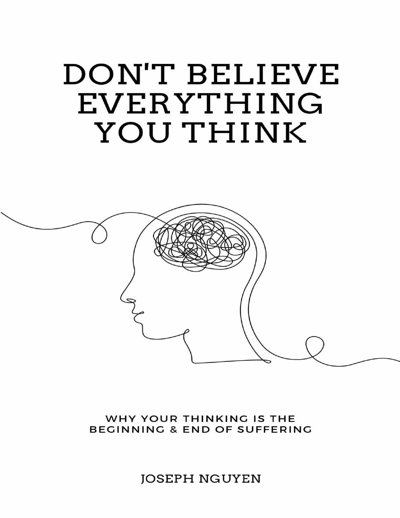
Today we’re answering a question a lot of you type into search: how do you stop overthinking? I’m using the tools from Don’t Believe Everything You Think by Joseph Nguyen, turned into a plan you can try this week.
The plan has three moves. Notice that a thought showed up. Stop arguing with it, and let the feeling be there. Then give it a little time and space. Everything else in this video is how to make those three moves easier. Fair warning, I’m a book reviewer, not a doctor.
Read This First
This is not medical advice. Overthinking can be a habit, but it can also be a symptom of anxiety, depression, trauma or other conditions that deserve proper care. If your worry is constant, if you can’t sleep or function, or if you ever think about hurting yourself, please contact a doctor, a therapist or a crisis line.
The book itself is a spiritual self help read, and the edition I read has no mental health disclaimer. So I’m taking the practical parts and leaving the cosmic ones. Think of this as a set of experiments you run on yourself, not a cure.
Lesson One: Thoughts Are Not Thinking
The first skill is the book’s main distinction. A thought is what pops into your head. Thinking is what you do with it afterward: replaying, judging, forecasting. Nguyen says you can’t control which thoughts appear, but you can notice when you start engaging with them.
Try his exercise. Write down the yearly income you’d love. Now multiply it by five and watch your mind. For most of us, the first number feels fine, then a stream of reasons arrives about why it’s silly or greedy. That second stream is the thing to catch.
Lesson Two: Thoughts Are Not Facts
Thoughts are not facts is a phrase a lot of you search, and it’s a line from the book’s own summary. Your brain says everyone at the party hated you. That is a thought, not a report. Saying it out loud to yourself as a thought can loosen its grip.
I’ll add some context. Therapists who use acceptance and commitment therapy teach a similar skill, called cognitive defusion. Cognitive behavioral therapy takes a different route, where you test whether the thought is accurate. Both have research support, though results vary by person and by problem.
Lesson Three: Thoughts Versus Feelings
Nguyen treats feelings as a dashboard. Light, energizing, curious means you’re in a flow of ideas. Heavy, tight, restricted often means you’ve gone into loops about an idea. He suggests using that heaviness as a signal to stop, not as proof the thought is true.
Here’s my honest caution. Feelings are real and can have causes beyond thinking, like poor sleep, hunger, hormones, illness or an actual problem. So use the dashboard as a clue. When it lights up, ask whether you’ve been spiraling, and also whether you need rest, food, or help.
Lesson Four: Let the Mud Settle
This is the technique people remember. Picture a jar of muddy water. If you stir it, it stays cloudy. If you leave it alone, the dirt sinks and it clears. Nguyen says the mind works the same way, and that trying to fix your thinking is the stirring.
So when you spiral, try doing less. Don’t analyze why you’re anxious. Don’t try to think positive, either. Sit, notice, and wait. It may feel awkward, because we’re used to solving things. Give it a few minutes before you judge whether it works.
Lesson Five: The Three Step Framework
The book’s closing guide boils the practice down. Step one, realize that when you’re suffering, you’re thinking, and don’t hunt for a deeper cause. Step two, make space for the feeling. He says you are the space that holds feelings, not the feelings themselves. Welcome the thinking in and let it be acknowledged.
Step three, let it pass without attaching to anything, and let any peace or ease arrive on its own. If the heavy feeling remains, go back to step one and repeat. It’s gentle, it’s repeatable, and it asks nothing from you except patience.
Anxiety at Three in the Morning
Let’s make that concrete. You wake up at three, and your mind starts listing everything that could go wrong. Instead of solving the list, say to yourself that this is thinking, the mud is being stirred. Let your body be heavy in bed and stop wrestling with each worry.
Here’s my own addition, and it isn’t in the book. Slow breathing, with a longer breath out, helps many people settle, so use it if it helps. If these nights are frequent, mention them to a doctor. Sleep trouble and anxiety often feed each other.
Measure Your Overthinking
The book ends with two reflection prompts. On a scale of one to ten, how much did you think today? And what percentage of your day was fight or flight versus relaxed? I like these because they turn a vague fog into a number you can watch.
Try it for a week at the same time every evening. You don’t need to be precise. The goal is to see patterns, like Mondays always hitting a nine, or Sunday walks sitting at a three. You’ll learn quickly what pushes your number up.
Audit Your Triggers
Next, his environment guide. Make a list of what puts you in a stressed state: foods and stimulants, a messy room, certain apps, news, group chats. If you can’t think of anything, keep a journal for a week and write down whatever makes you tense.
Sort the list into physical health, physical space, digital environment and what you consume. Rank each item and remove the top ones, but only what is manageable. He insists on starting small, because removing too much at once just adds stress. A good first move is muting one app.
Start the Morning Gently
He says how you start your day creates momentum. If you grab your phone, emails and to do list first, you begin in a fight or flight mode that carries all day. His suggested fix is an activation ritual, a short routine that gets you calm before the world arrives.
It can be tiny: stretching, a walk, journaling, a slow cup of tea, ten minutes of quiet. Plan the version you will really do, not the perfect one. Start small, and add things only after the first one is a habit.
Deciding Without the Pros and Cons Spiral
Overthinkers love lists and asking everyone for advice. Nguyen says that’s a trap, because most of the time you already know what you want and are afraid to do it. His test question strips the pressure: if you had infinite money, no fear and no audience, what would you do?
I like it as a tool to find your honest preference. I’d use it alongside real information, though, especially for big money, health or legal decisions. A gut feeling is a clue, not a license to skip the facts.
Make Work Less Draining
The work framework is practical. List what drains you, list what energizes you, and give each task a score from one to ten. Each week, drop one to three of the lowest items and do more of the nines and tens. The long term goal he sets is spending eighty percent of your time on nines and tens.
You may not control your job, so start with your own tasks. Even a small shift, like batching a task you dread or asking to swap one duty, can lower the daily heaviness that feeds overthinking.
Habits and the Hundred Percent Question
For stubborn habits, the book gives a long list of questions. Write down exactly what you do. What feeling comes right before it? What are you telling yourself? What do you believe will happen if you don’t do it? Then ask whether it is absolutely, one hundred percent true.
That last question is the heart of it. Most fears fall apart a little when you look at them in detail. It is close to what cognitive therapists do, so it’s worth trying. If the habit involves addiction, though, please use professional support alongside it.
Three Mistakes to Avoid
First, don’t turn this into another thing to fail at. The book itself says you will bounce between thinking and calm, and that punishing yourself for thinking only creates more thinking. Catching it is the practice, and you’ll catch it late at first.
Second, don’t use it to dismiss real problems. A thought can be wrong, but it can also be a useful warning about a bill, a symptom or an unsafe relationship. Third, don’t tell other people to just stop thinking. That advice stings, and the book’s own tone is kinder than that.
A Seven Day Experiment
Here’s the plan. Day one, rate your thinking from one to ten. Day two, practice naming a thought as a thought. Day three, try the settling pause during one spiral. Day four, list your triggers. Day five, trim one. Day six, design a small morning routine. Day seven, review your numbers and keep what helped.
Notice the pattern: it’s all small, and nothing asks you to believe in anything. If a step feels useless, drop it. Keeping a tool that works for you matters more than agreeing with every claim in the book.
Before You Go
If these tools help, great. If you feel worse or stuck, that’s not a failure of willpower, it may be a sign you’d benefit from a therapist’s guidance. Asking for help is a very practical skill.
Now tell me in the comments: when do you overthink the most, and which of these steps will you try first? If this plan helped, subscribe and I’ll see you in the next book breakdown.