📝 Summary · Summary
How to Win Friends and Influence People Summary: All 30 Principles
A plain-language summary of How to Win Friends and Influence People by Dale Carnegie: all thirty principles in four parts.
Thirty simple principles for being liked, persuading people and leading without causing resentment, from a classic of the 1930s.
Simple, practical and surprisingly hard to practice, held back by dated examples, repetition and the worry that some techniques can look like tricks. Four out of five.
Every guide comes as a video and a full written article. Pick the one you need: the review is spoiler-free, the ending explained is not.
A plain-language summary of How to Win Friends and Influence People by Dale Carnegie: all thirty principles in four parts.

Is Dale Carnegie's How to Win Friends and Influence People still worth reading? An honest review: the four parts, what works, what feels dated and my score.

Six habits from Dale Carnegie's classic that still work today, from listening to saving face, plus one honest worry.

Loved Carnegie's classic? Six books about communication and persuasion: Influence, Crucial Conversations, Never Split the Difference and more.
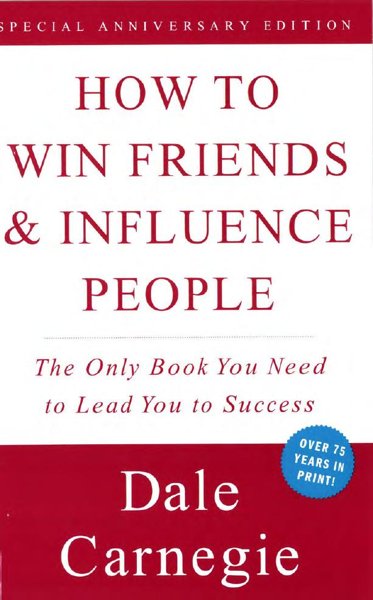
How to Win Friends and Influence People is a self-help classic by Dale Carnegie, who taught public speaking and human relations before collecting his stories and advice into thirty principles across four parts.
Below you’ll find a review, a summary of all thirty principles, six habits that still work, and six books to read next.
Dale Carnegie taught public speaking and human relations classes long before he wrote this book. He collected stories from those classes, from famous people, and from ordinary students, and turned them into a set of principles for getting along with others.
The book is divided into four parts. The first covers the basics of handling people. The second gives six ways to make people like you. The third gives twelve ways to win people to your way of thinking. The fourth gives nine ways to be a leader without causing resentment.
It opens with a famous story about a killer named Two Gun Crowley, who thought of himself as a good person, to show that almost nobody sees themselves as the villain.
Dale Carnegie taught public speaking and human relations classes long before he wrote this book. He collected stories from those classes, from famous people, and from ordinary students, and turned them into a set of principles for getting along with others.
Simple, practical and surprisingly hard to practice, held back by dated examples, repetition and the worry that some techniques can look like tricks. Four out of five. Read it if: you want practical, easy habits for work and relationships; you have ever lost an argument by winning it; you like short chapters and plenty of stories. Skip it if: you want rigorous research and data; you dislike self-help language; you want a modern, up-to-date take. Review: How to Win Friends and Influence People →
A plain-language summary of How to Win Friends and Influence People by Dale Carnegie: all thirty principles in four parts. Summary: How to Win Friends and Influence People →
Influence by Robert Cialdini, Crucial Conversations by Kerry Patterson, Joseph Grenny, Ron McMillan and Al Switzler, Never Split the Difference by Chris Voss, Getting to Yes by Roger Fisher and William Ury, Nonviolent Communication by Marshall B. Rosenberg, The Charisma Myth by Olivia Fox Cabane. Books like it: How to Win Friends and Influence People →
Thirty, in four parts: three for handling people, six for making people like you, twelve for winning people to your way of thinking and nine for being a leader.
That people want to feel important, and you influence them best through sincere interest, honest appreciation and respect for their point of view.
Many readers find the core habits, such as listening and avoiding criticism, still useful. Some examples and language feel dated. That is the reviewer's opinion.
Amazon links. We may earn a commission if you buy through them.