The Verdict
It’s a tiny book with four rules you can remember in a minute, and for a lot of people those rules genuinely help. It also leans on spiritual claims and big numbers that it never backs up. My verdict: worth an evening, if you keep the rules and leave the mythology. I give it three and a half out of five, and this review is spoiler free.
What It’s About
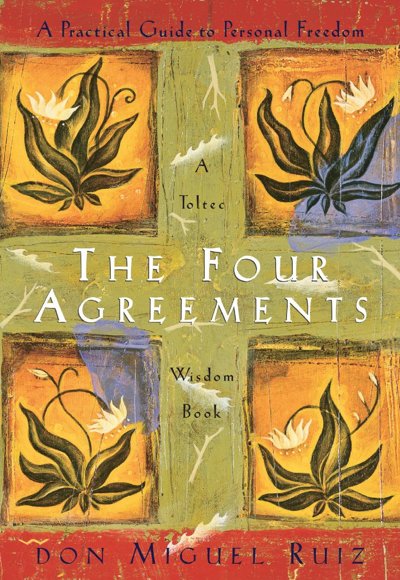
The Four Agreements came out in nineteen ninety seven, with the subtitle A Practical Guide to Personal Freedom. It’s short enough to finish in one sitting, and I went through all of it, from the opening chapter on domestication to the prayers at the very end.
Ruiz presents it as Toltec wisdom, passed down through his family. His core idea is simple. From the day we’re born, we sign up for beliefs we never chose. He calls those beliefs agreements, and he says they quietly run our lives. The book offers four new agreements to replace the old ones.
It even opens with a short legend, The Smokey Mirror, about a man who realizes everything is made of light. It sets a mystical tone, and you’ll know quickly whether that’s your thing.
Why It Sold
Ruiz was born in Mexico and trained in medicine. Biographies describe a near fatal car crash that reportedly sent him back toward his family’s Toltec tradition.
The book came out from a small publisher, Amber-Allen, and spread by word of mouth, until Oprah Winfrey began championing it around the year two thousand. It has reportedly been a New York Times bestseller for more than a decade, and sales figures vary by source. The publisher has claimed more than eight million copies in the United States, as of October twenty twenty six.
The Big Idea
Before the agreements, you get the diagnosis, and it’s the most interesting part of the book. Ruiz says we’re trained like animals, with punishment and reward, until we become our own trainer.
Inside your head, he says, sits a Judge who decides you’re guilty, and a Victim who takes the blame. The rulebook they work from, he calls the Book of Law. Then comes the line that stuck with me: humans are the only animal that pays a thousand times for the same mistake.
On top of that, he says our minds sit in a fog he calls the mitote, a marketplace where a thousand voices talk at once. His promise is that four simple agreements can clear the fog, and let you dream a happier life.
The First Agreement
The first agreement is: be impeccable with your word. Ruiz calls it the most important and the hardest. He says impeccable means without sin, and he defines sin as anything you do against yourself.
So this one is about honesty, about gossip, and about the cruel things you say to yourself. His example is a tired mother who tells her singing daughter she has an ugly voice. The girl never sings again. One careless sentence became a spell.
He’s just as hard on self talk. We tell ourselves we look fat, or stupid, or never good enough, and he asks you to notice how often you use your word against yourself. His cure is to tell yourself the truth, and to speak to yourself with love.
The Second Agreement
The second agreement is: don’t take anything personally. What people say about you, he argues, comes from their own beliefs and their own fear, not from you.
If a stranger calls you stupid, that tells you about the stranger. Ruiz promises that if you stop eating other people’s emotional garbage, you become immune to their poison. It’s the agreement I’d hand to anyone who replays one rude comment all night.
He practices it in public. Ruiz says it doesn’t matter to him whether people call him an angel or call him a devil, because either way it’s about them. Praise gets the same treatment: you don’t need to believe the nice things, either.
The Third Agreement
The third agreement is: don’t make assumptions. We guess what people mean, believe the guess, and then argue with it.
His mall example made me smile. Someone you like smiles at you, and by the time they’ve walked away you’ve built a whole relationship in your head. The fix is plain: ask questions, and ask for what you want. Everyone gets to say yes or no, but you always get to ask.
He also warns against one assumption in particular, the belief that your love will change this person. His answer is blunt: your love will not change anybody. People change when they want to.
The Fourth Agreement
The fourth agreement is: always do your best. No more, and no less. Your best changes with your mood, your health and your sleep, so it won’t be the same every day.
There’s a story about a student who wants to meditate eight hours a day to finish faster. The teacher says that will take twenty years instead of ten. This agreement is the glue for the other three, because it lets you fall short without punishing yourself. If you slip, you start again tomorrow.
He adds a point about motivation. Plenty of people work all week for payday and resist every hour, while doing your best means acting because you enjoy the action, without chasing the reward.
The Toltec Path
The last two chapters zoom out. Ruiz says the path to freedom starts with awareness, then transformation, then what he calls intent, which he describes as love. He compares the Judge, the Victim and the belief system to a parasite that feeds on fear.
His advice is to forgive, because holding grudges means paying again for old mistakes. He also suggests imagining life with one week left, so you stop living for other people’s approval. The book ends with a vision he calls heaven on earth, and one question: suffering or happiness, which will you choose?
What Works
First, it’s portable. Four short sentences you can carry into an awkward meeting or a family argument. Most self help books can’t be summed up like that.
Second, the fourth agreement is quietly kind. It attacks perfectionism and self blame, and it gives you permission to be a work in progress.
Third, the everyday examples. Gossip as a computer virus, partners who say you should have known. Those land because you’ve lived them.
And fourth, Ruiz admits he fell many times and kept going, which makes the whole thing feel human.
Writing and Pacing
The writing is plain and direct. Ruiz talks straight to you, mixing personal stories with short parables, and the chapters are brisk.
The pacing is lopsided, though. The four agreements are covered in clean, separate chapters, and the early going is the tightest. Then the final third shifts to warriors, parasites and prayers. It’s gentler to read than to argue with, and the repetition does the persuading, not the evidence.
What Doesn’t Work
Now the honest part. First, it repeats itself. Hell, poison and black magic come back chapter after chapter, and the images get heavy.
Second, the later chapters turn mystical. There is a parasite living in your mind, a symbolic initiation of the dead, and the claim that everything is God. You may love that, but it’s a different book from the practical guide on the cover.
Third, it tells you what to do but not how. The advice is basically, use your strong will and keep going. That’s honest, but thin.
Does It Hold Up
Does it hold up? Partly. The book states big numbers with no source, like the claim that ninety five percent of our beliefs are lies. And historians treat the Toltec as a half legendary culture, while one academic study argues that today’s Toltec spirituality has drifted far from the real archaeological one.
In fairness, Ruiz never claims to be a historian. He offers a personal tradition, and the four rules work without the backstory. In my opinion they echo ideas from cognitive therapy, like questioning your assumptions and being kinder to yourself.
There’s a risk, too. Not taking things personally can be twisted into tolerating bad treatment. To his credit, Ruiz does say walking away from someone who won’t treat you with respect is a gift. But the last chapter’s claim that you suffer only because you choose to is a hard line for anyone with depression or trauma. This is no replacement for therapy.
The Scorecard
My scores. Ideas, four out of five. Practical use, four. Readability, four and a half. Evidence, two. Depth, three. That averages out to three and a half. These are my opinions, so argue with me in the comments.
Who It’s For
Read it if you want a short, friendly start in self help, if you overthink what people say, or if you like one simple framework. Skip it if you want evidence based psychology, or if spiritual language puts you off.
If you like this, try The Power of Now by Eckhart Tolle, The Untethered Soul by Michael Singer, or the Meditations of Marcus Aurelius.
Where To Get It
The Four Agreements is widely available in print, ebook and audiobook, and you’ll find links below. Ruiz also wrote a sequel with his son, The Fifth Agreement, and a book about relationships called The Mastery of Love.
Tell me in the comments: which of the four agreements do you break the most? Thanks for watching, and subscribe for more books explained.