The Short Version
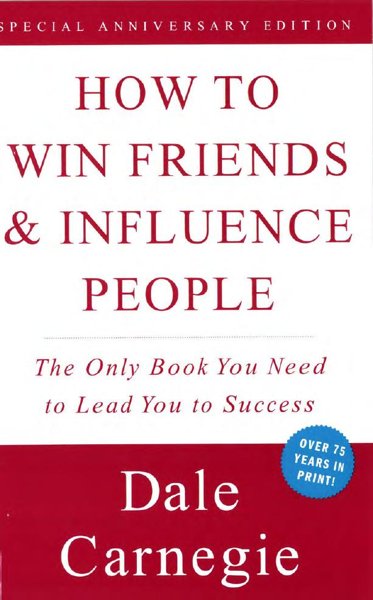
How to Win Friends and Influence People is a self-help classic by Dale Carnegie, who taught public speaking and human relations before collecting his stories and advice into thirty principles across four parts. It works well for a book club because there is no plot to spoil, the chapters are short, and everyone can test the advice on their own lives before the meeting.
Below are fourteen discussion questions, followed by an applying-it section for the week after your meeting. The book scores four out of five in our review: simple, practical and surprisingly hard to practice, held back by dated examples, repetition and the worry that some techniques look like tricks.
Discussion Questions
- The book opens with Two Gun Crowley, a killer who thought of himself as a good person. What point is Carnegie making about how nobody sees themselves as the villain?
- Principle one is don’t criticize, condemn, or complain. Carnegie says criticism puts people on the defensive so they justify themselves instead of changing. Has that matched your experience, at work or at home?
- The core idea is that people want to feel important. Do you agree, and does it change how you read ordinary conversations?
- Principle two is to give honest and sincere appreciation. Where is the line between sincere appreciation and flattery?
- Part two says a person’s name is the sweetest sound in any language. How do you feel when someone remembers yours, or forgets it?
- Carnegie says to be a good listener and encourage others to talk about themselves. Is listening really a skill, or is it just patience?
- Part three says the only way to win an argument is to avoid it. Is there ever an argument worth winning outright?
- Another principle says if you are wrong, admit it quickly and emphatically. Why is that so hard to do in practice?
- Carnegie asks you to let the other person feel the idea is theirs. Is that a respectful way to persuade, or a quiet kind of manipulation?
- Part four covers leading without causing resentment: begin with praise, call attention to mistakes indirectly, ask questions instead of giving orders and let the other person save face. Which of these would your own boss benefit from most?
- Our review notes that some examples are from the early twentieth century and some language about men and women has aged badly. Did the dated material distract you, or does the advice still hold?
- The book has plenty of stories but little research, and we score its evidence three out of five. Did the stories convince you, or did you want data?
- Smiling and remembering names can look like tricks. Carnegie insists they must be sincere. Can a habit start as a technique and become sincere over time?
- After the first few chapters the pattern is a story, a principle, another story, the same principle. Did the repetition help you remember, or did it wear thin?
Applying It: A Week Of Practice
Ask each member to pick one principle before the meeting ends and report back at the next one. Good options from the book are to skip criticism, learn and use names, ask one real question in every conversation and wait for the whole answer, admit a mistake quickly and let someone save face. The simplest place to start is listening. Afterward, compare notes:
- Which habit felt natural, and which felt like an act?
- Did anyone catch themselves about to criticize, and what did they do instead?
- Did anyone see a different reaction from a person they tried it on?
- If you tried a technique and it felt fake, what would make it sincere?
About The Book
Carnegie collected stories from his classes, from famous people such as Abraham Lincoln and from ordinary students. The book has four parts: handling people, making people like you, winning people to your way of thinking, and being a leader. Part three holds twelve of the thirty principles, split between avoiding arguments and persuading.
What To Read Next
Our review gives a spoiler-free verdict, and our summary page lists all thirty principles in plain language. The lessons page covers six habits that still work. If your group wants more, our books-like-it list covers six titles on persuasion, negotiation and communication, some with more research behind them.