Two Books, One Idea
Two books sit on that board. One is a Japanese bestseller written as an argument between a philosopher and a young man. The other began as a short video about a prom. And at the heart of both is one uncomfortable sentence: what other people think, say and do is not yours to control.
Here is the short answer, and it is my opinion. The Courage to Be Disliked goes deeper, argues harder and explains why the idea works. The Let Them Theory is easier to use on a bad Tuesday, and its friendship chapters are the best part. If you want to be challenged, start with Courage. If you want a tool for tomorrow, start with Let Them.
Below is a side by side idea map, where each book is stronger, and who should read which. Both are non fiction, so there are no spoilers. I searched the full text of both ebooks for the counts you will see.
Where Each Book Comes From
The Courage to Be Disliked is by Ichiro Kishimi and Fumitake Koga. It came out in Japan in twenty thirteen, under the title Kirawareru Yuki. The English translation followed in twenty seventeen, and the Atria hardcover in May twenty eighteen.
The authors call it a distillation of the ideas of Alfred Adler, told as five long conversations between a philosopher and a young librarian who argues with every point. I will only report what the book says Adler taught. I did not check Adler’s own writing, so treat those lines as the book’s claims.
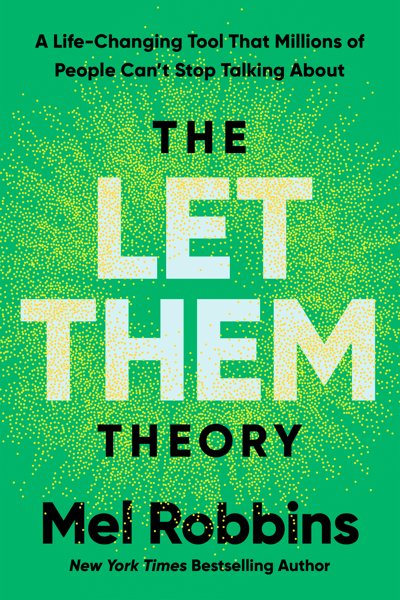
The Let Them Theory is by Mel Robbins, written with her daughter Sawyer, and it is from twenty twenty four. It starts at a prom. Mel’s daughter told her to let the kids go to a taco place in the rain, and a short video about it passed fifteen million views in a day, by the book’s own account.
Mel says the idea is rooted in Stoicism, Buddhism, radical acceptance and detachment theory. Here is a number I counted. Adler or Adlerian appears two hundred seventeen times in Courage. In Let Them, it appears zero times. Same core idea, different family tree.
The Idea Map
Start with Courage. The idea is called separation of tasks, and the book boils it down to one question: whose task is this? To answer it, ask who will ultimately receive the result of the choice.
The book’s examples are plain. A child’s studying is the child’s task, because the child gets the result. How your parents feel about your career is their task. Whether someone likes you is their task. By my count, the phrase separation of tasks appears forty five times.
Now Let Them. It has two steps. Let Them means you stop trying to control other adults, their opinions, moods and choices. Let Me means you take responsibility for your own response and your next move. Mel says Let Them is only the first half of the equation, and the capitalised words Let Them appear four hundred eighty four times.
So here is the map, side by side. Whose task is this lines up with what can I control. Do not intrude lines up with Let Them. And what you still own lines up with Let Me. Different words, one fence line.
Same Core, Different Engine
Here is where they really overlap. Both say you cannot change another adult by pushing. Courage borrows an old proverb: you can lead a horse to water, but you cannot make him drink. Mel’s version is that pressure does not create change, it creates resistance.
Both also reject the cold version. The philosopher says this is not noninterference. You stay interested, and ready to help when asked. Mel says Let Them does not mean leave them alone. In both books you let people own their choices, and you stay kind and available.
Both take on the fear of being disliked. The philosopher says that to please ten people, you must swear loyalty to all ten, and that means lying to yourself. Mel tells you to assume some people will think badly of you, and to let them. One calls it courage, the other calls it letting them think what they want.
The engine is different. Courage argues from a theory of why people suffer: the book says we act on present goals, not past causes, and that all problems are problems between people. Let Them argues from experience, her own prom, her own friendships, and experts she names. One is a philosophy. The other is a habit.
One Situation, Two Answers
Take one situation: someone close to you disapproves of a choice you made. Courage’s own example is parents who oppose your job. The philosopher says how they handle their disapproval is their task, not yours, and that you should walk the path you believe in without lying about it.
Let Them has a different example. Mel scrolls through photos of a girls’ weekend she was not invited to, and her husband asks why she cares so much. She says Let Them to the hurt, and the urge to text and smooth things over fades. That is step one.
Then comes Let Me. She reaches out, but not to win an invite. She reaches out because she realised she actually misses a few of those women.
Notice the shape. Courage ends at not intruding and keeping your own course. Let Them adds a second move: do something with the energy you got back. In my view, that second move is the biggest practical gap between the two. Courage would say that move lives in its later nights, in contribution.
Where Courage Is Stronger
Courage is stronger on why. It does not stop at tell yourself it is not your problem. It asks why you needed their approval in the first place, and the philosopher’s answer is that you were living on other people’s expectations, which he calls an unfree way to live.
It also gives you something to hold. The philosopher says you always hold the cards in a relationship. His story is a father who hit him. He chose to repair things, whatever his father did, and years later, while caring for him, he heard the words thank you. It is one man’s story, not a study.
And it goes further than tasks. The book calls separation of tasks the gateway, not the goal. The later nights are about community feeling and contributing to others, and one line says happiness is the feeling of contribution. That is a bigger promise than a calmer Tuesday.
But it is demanding, and parts are contested. The book denies trauma outright. Its philosopher admits that Adler’s ideas run against normal social thinking, and the young man calls one idea religious. He is a character who comes round in the end. This is not medical advice, so read it as one view, not settled science.
Where Let Them Is Stronger
Let Them is stronger on how. Each chapter ends with a problem, a truth and a solution, and the book lives in daily scenes: a coughing stranger on a plane, a boss who strings you along, a friend group that left you off a weekend away.
Its friendship chapters are the best part, in my view. Mel names three pillars of friendship, proximity, timing and energy, and her advice is to go first. Courage treats friendship as a life task, but it gives you much less to try on a Monday morning.
It also has a built in warning. Let Them is only half the tool, and if it leaves you lonely, she says you are using it wrong. It is no excuse to ignore dangerous behavior. If someone is in danger, you step in, take the keys, call for help. And the book is about adults, not children.
The weaker side is evidence. Figures like seven in ten people living in chronic stress are credited to a named expert, but not to a study you can check, and the bibliography is alphabetical, so claims and sources are not linked. In my view it is also one idea stretched over twenty chapters.
Which One To Read
Now the part that is only my opinion. Read The Courage to Be Disliked if you like to argue with an idea, if you are tired of living for approval, or if you read Let Them and wanted to know what sits underneath.
Read The Let Them Theory if you want short scenes and scripts, if friendships are your sore spot, or if a long philosophical dialogue sounds like homework. Skip it if you want research you can check line by line.
One warning for both. Neither book is a license to ignore people who need you. Courage says you still give all the help you can, and Let Them says do not use it to ghost people or dodge hard talks.
If you want both, my order is Courage first for the why, then Let Them for the how. If you can only pick one, and what you need is a phrase to say in the moment, my pick is Let Them. If you want a book to change how you think, my pick is Courage.
Your Turn
I have a full summary and a review of The Let Them Theory on this channel, and the links are below. Those cover that book on its own.
Tell me in the comments: which would you rather try first, a philosophy that says freedom means being disliked, or two words you can say in the moment? Subscribe, tap like if you want more book against book comparisons, and I will see you in the next one.