The Short Version
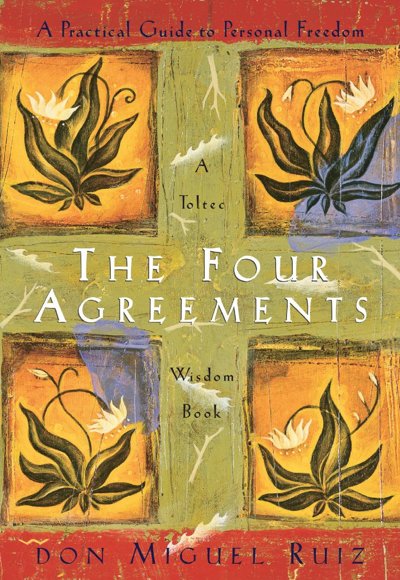
The Four Agreements (1997), subtitled A Practical Guide to Personal Freedom, is don Miguel Ruiz’s short book built on what he presents as Toltec wisdom. His idea is that from the day we are born we sign up for beliefs we never chose, and that four new agreements can replace them: be impeccable with your word, don’t take anything personally, don’t make assumptions, and always do your best. It suits a book club because it is short enough to finish in one sitting, and because most people have one agreement they love and one they argue with.
Our review scores it three and a half out of five: four memorable, kind rules that genuinely help, wrapped in mystical claims and big numbers the book never backs up. Keep the rules, skip the mythology. This guide is a set of discussion questions about a book, not advice, and it is no replacement for a therapist.
Discussion Questions
- Ruiz says we are trained like animals with punishment and reward until we become our own trainer, working from what he calls the Book of Law. Does this diagnosis ring true to you?
- Inside us, he says, a Judge decides we are guilty and a Victim takes the blame. Which voice is louder in your head?
- He writes that humans are the only animal that pays a thousand times for the same mistake. Where have you done that?
- The first agreement is to be impeccable with your word, which he defines as not doing anything against yourself. He compares gossip to a computer virus and tells of a mother who calls her singing daughter’s voice ugly. Which example hit hardest?
- How often do you use your word against yourself, with thoughts like “I look fat” or “I’m never good enough”? Is speaking to yourself with love realistic?
- The second agreement is not to take anything personally, because what people say comes from their own beliefs and fears. When did that idea last help you, and when did it feel like an excuse to ignore feedback?
- Our review notes that this agreement can be twisted into tolerating bad treatment, though Ruiz says walking away from someone who won’t treat you with respect is a gift. Where is the line?
- The third agreement is not to make assumptions. His example is the husband and wife where she thinks he should have known. Describe a time an assumption caused trouble in your life.
- Ruiz says your love will not change anybody, and that people change when they want to. Do you agree?
- The fourth agreement is to always do your best, no more and no less, and he says your best changes with your mood, health and sleep. Does this relieve perfectionism or excuse laziness?
- Our review calls the fourth agreement the glue for the other three. If you slip, you begin again tomorrow. Do you agree it works that way?
- The book states that ninety-five percent of our beliefs are lies, with no source, and later chapters turn mystical with a parasite in the mind. How much of the mythology can you accept while keeping the rules?
- Ruiz says you suffer only because you choose to. Our review calls this a hard line for anyone with depression or trauma. How should a reader treat a sweeping claim like that?
Applying It
Pick one agreement to practice for a week. For the first, notice when you gossip or criticize yourself. For the second, pause before replying to a cold message. For the third, ask a question instead of guessing. For the fourth, finish what a tired person can honestly finish and stop. Then report back to the group on which one was hardest.
What Is The Toltec Claim
Ruiz presents the book as Toltec wisdom passed down through his family, and biographies describe a near-fatal car crash that reportedly sent him back toward his family’s tradition. Our review notes that historians treat the Toltec as a half-legendary culture, and that one academic study argues today’s Toltec spirituality has drifted far from the archaeological one. In fairness, Ruiz never claims to be a historian, and the four rules work without the backstory. The book came out from a small publisher, Amber-Allen, and spread by word of mouth, helped when Oprah Winfrey began championing it around 2000.
What To Read Next
Our review walks through each agreement and the fair criticisms, and our summary page tests each agreement on an ordinary day. The review also suggests The Power of Now by Eckhart Tolle, The Untethered Soul by Michael Singer and the Meditations of Marcus Aurelius. Ruiz also wrote The Fifth Agreement with his son and The Mastery of Love.