The Short Version
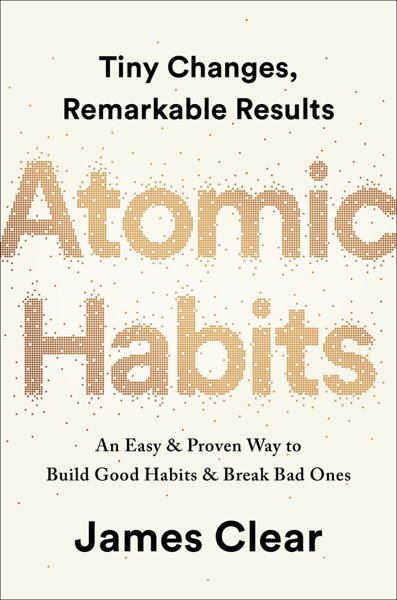
James Clear’s Atomic Habits, published in 2018, is a good club pick because everyone has a habit they want to build or break, and the book gives the group concrete tools to argue over. Its big ideas are getting one percent better every day, focusing on systems instead of goals, building habits around identity, and using the Four Laws of Behavior Change: make it obvious, attractive, easy and satisfying.
Below are fourteen discussion questions plus a section on applying the book together. A short section on the book’s background gives the group a few facts to check. The book scores four out of five in our review, with top marks for usefulness and clarity and lower scores for evidence and originality.
Discussion Questions
- Clear opens with his own story: a classmate’s baseball bat hit him in the face, he had seizures and a medically induced coma, and six years later he was named his college’s top male athlete. He says there was no single turning point, only many small habits. Did that story persuade you?
- If you get one percent better every day for a year, you end up about thirty-seven times better. Does the math feel useful, or too neat?
- Clear describes the Plateau of Latent Potential with an ice cube in a cold room that only melts at thirty-two degrees. When have you quit just before the results showed up?
- He says you do not rise to the level of your goals, you fall to the level of your systems. Do you agree that goals alone are not enough?
- Clear argues that every action is a vote for the person you want to become, and that “I’m not a smoker” is stronger than “I’m trying to quit.” Is identity really the deepest layer of change?
- The book breaks every habit into cue, craving, response and reward. Pick one of your own habits and walk through the loop. Which step is the weak link?
- After the Vietnam War, around twenty percent of American soldiers there were addicted to heroin, but only about five percent relapsed within a year of coming home. Does this convince you that environment matters more than willpower?
- The British Cycling story opens the book, but our review points out that the same program later faced controversy, including a 2018 UK parliamentary committee report on Team Sky that the team disputed. How should a reader treat tidy success stories?
- Which of the tools sounds most usable to you: the Habits Scorecard, implementation intentions, habit stacking, temptation bundling, the Two-Minute Rule or habit trackers?
- Clear’s rule is never miss twice. Is one missed day really an accident and two the start of a pattern?
- Chapter eighteen uses Michael Phelps and the runner Hicham El Guerrouj to argue that you should pick habits and games that fit your nature. Did that feel honest, or like a loophole?
- Our review says the book is very individual and says little about money, time or health limits. Whose situation does it fit least well?
- Clear openly credits Charles Duhigg’s The Power of Habit and others, and our review calls his contribution packaging. Is great packaging enough to justify a book?
- Our review says a tighter edit could cut fifty pages because of the repetition. Did the chapter summaries and cheat sheets help you or wear you down?
Applying It Together
Pick one habit each and shrink it with the Two-Minute Rule, so that being a reader starts with one page and being a runner starts with putting on your shoes. Write an implementation intention in the form of what you will do, when and where, or stack it after something you already do, such as after you brush your teeth.
Then work one Law at a time. In week one make the cue obvious, in week two attach a treat to the habit, in week three remove friction, and in week four add a tracker and an immediate reward. Report back at the next meeting on what you tried, what you skipped and whether you missed twice. To break a bad habit, flip the laws: hide the cue, list the real costs, add steps and find an accountability partner.
About The Book
Atomic Habits is about three hundred pages in twenty chapters, plus an introduction, a conclusion and bonus sections on business and parenting. It has reportedly sold more than twenty-five million copies. The audiobook is narrated by Clear himself. James Clear built his audience through a free newsletter and blog before the book.
What To Read Next
If your group wants to decide first, start with our review. Our summary covers the whole book in ten minutes, our practical thirty-day plan turns it into a month of action, and our books-like-it list covers seven picks including The Power of Habit, Tiny Habits, Deep Work and Four Thousand Weeks.