The Verdict
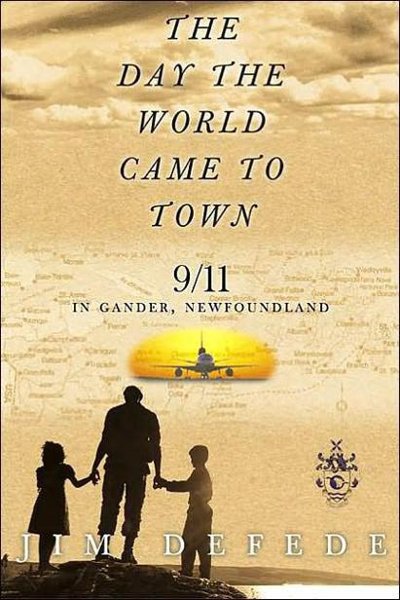
Today’s book is a true story that inspired a hit Broadway musical: The Day the World Came to Town, by journalist Jim DeFede. It’s about what happened in Gander, Newfoundland, on September eleventh, two thousand one.
My verdict: read it. It’s one of the most comforting books about one of the darkest days in modern history. It’s short, warm and full of kindness. The writing is plain journalism, and there are a lot of people to keep track of, but I give it four and a half out of five.
What It’s About
On the morning of September eleventh, after the attacks in New York and Washington, the United States closed its airspace. Hundreds of planes over the Atlantic had to land somewhere else.
Thirty eight of them landed in Gander, a small town in Newfoundland with a population of barely ten thousand. Suddenly, more than six and a half thousand passengers and crew needed food, beds, medicine and comfort, for days. This book is about how the town, and the villages around it, took care of them.
The Book At A Glance
It was published in two thousand two, less than a year after the events. It’s about two hundred and fifty pages, organized day by day, from Tuesday the eleventh to the following Sunday, with an epilogue.
DeFede is a reporter, and he interviewed passengers, pilots, police, teachers and volunteers. Each chapter cuts between a handful of real people, so it reads almost like a novel.
Why Gander
There’s a great piece of history in the book. Gander’s airport opened in nineteen thirty eight, and for a while it was the largest airport in the world, because planes crossing the Atlantic had to stop there to refuel.
By two thousand one, most jets didn’t need to stop anymore. But Gander still had a huge runway system, which made it the perfect place to bring down dozens of jumbo jets in an emergency.
What Works
First, the kindness. Locals open their homes, schools, churches and Lions Clubs. Pharmacists track down passengers’ medications and order thousands of toothbrushes. The phone company sets up free long-distance calls on the sidewalk. School bus drivers who were on strike put the strike on hold to drive the passengers. It’s overwhelming in the best way.
Second, the people. You meet a couple flying home from Kazakhstan with a newly adopted daughter, a New York mother waiting for news of her firefighter son, a rabbi, a group of refugees from Moldova, airline pilots, and the airport staff who take care of animals stuck in the cargo holds.
Third, the balance. The book never forgets what’s happening in New York, Washington and Pennsylvania. The kindness in Gander is set against real grief and fear, which makes it feel honest rather than sugary.
And fourth, the humor. Newfoundlanders are funny, and DeFede captures it, from the local accent to the infamous “Screech-in” ceremony, which involves cheap rum and kissing a fish.
The Stories You’ll Remember
A few stories stay with you. Hannah O’Rourke, a passenger whose son Kevin was a New York firefighter missing at the World Trade Center, and the locals who prayed with her. A rabbi on one of the planes who met a local man who had never told his neighbors he was Jewish. And Moldovan families who couldn’t speak English, communicating with Baptist volunteers through charades.
Then there’s the airport team caring for the animals on board, including a pair of rare bonobo apes, and a puppy named Ralph.
Writing And Structure
The writing is clear, straightforward newspaper prose. It’s not literary, but it’s warm and well paced. The day-by-day structure builds nicely, from shock to routine to the bittersweet goodbyes.
The downside of so many characters is that some blur together. It helps to keep a mental list, or to have seen Come From Away first.
What Doesn’t Work
Now the honest part. First, there are a lot of names, and the book jumps between dozens of people across several towns. Some readers find it hard to follow.
Second, it was written quickly, within a year, so it lacks the long-term perspective you might want. You don’t find out much about what happened to many people later.
Third, it’s almost entirely positive. That’s the point, and it’s true to what people reported, but if you want a critical look at the response, this isn’t that book.
Who It’s For
Read it if you loved Come From Away, if you need a hopeful book about human kindness, or if you’re looking for a short, true story for a book club or a classroom.
Skip it if you want literary nonfiction, or if you’re not ready to revisit September eleventh, even through a gentle lens.
The Scorecard
My scores. Heart, five out of five. Story, five. Characters, four and a half. History, four. Writing, three and a half. That’s an average of about four point four, so four and a half out of five.
Where To Go Next
I also made a video on the true story and the numbers, a book versus Come From Away comparison, and a list of similar books. They’re linked below. Tell me in the comments: have you seen Come From Away?