The Verdict
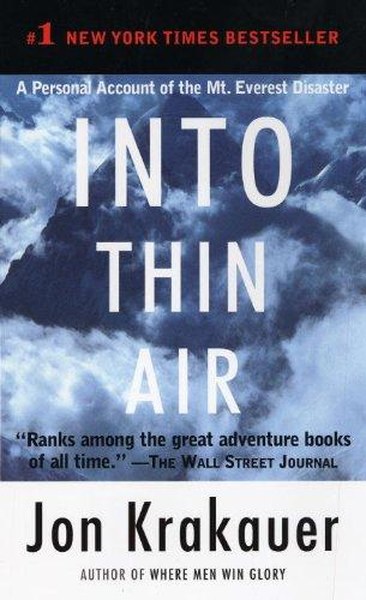
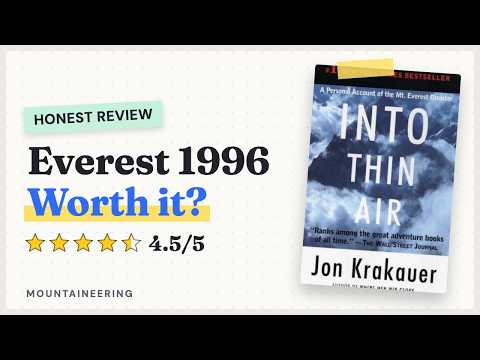
Today I’m giving you my honest review of Into Thin Air, Jon Krakauer’s firsthand account of the nineteen ninety-six disaster on Mount Everest, a book that is very hard to shake once you’ve read it.
So, is it worth reading? Yes. It is a gripping, carefully reported piece of true storytelling, and it asks hard questions without pretending to have tidy answers. A few parts are disputed, and some readers find it harsh. I give it four and a half out of five. One warning: it deals with death, frostbite and grief, and it has strong language.
What It’s About
In March of nineteen ninety-six, Outside magazine sent Jon Krakauer to Nepal to join a guided climb of Mount Everest and write about how the mountain had become a business. He went as one of eight paying clients on a team led by a famous New Zealand guide, Rob Hall.
This is a true story, and the outline is public history. A storm struck the upper mountain while many climbers were still high up, and people died. I won’t walk through who or when. The book is Krakauer’s attempt to say what he saw, and what he believes went wrong.
How The Book Came To Be
The book began as a magazine article. Krakauer says he delivered it five weeks after he got home, seventeen thousand words, four or five times a normal feature. And he still felt it was too short to do justice to what had happened.
So he kept going. The book is the fruit of that compulsion, written within months, while the memories were raw. He admits that readers are often poorly served when an author writes as an act of catharsis, as he does here, and then he does it anyway, on purpose, for the honesty.
The Shape Of It
The book runs to about ninety-eight thousand words, in twenty-one chapters, plus an epilogue and a long postscript added in nineteen ninety-nine. Nearly every chapter heading gives a place, a date and an altitude, so you feel the climb. Chapter one drops you on the summit, then the book rewinds to the beginning.
The first half is slow on purpose: Kathmandu, the trek, Base Camp, weeks of getting used to the thin air. Then the clock starts, and the last third reads like a countdown.
What Works: The Reporting
My first favorite thing is how honest the reporting is about its own limits. Krakauer explains that at altitude the mind is unreliable. He once asked three people to recount something all four of them had witnessed, and none of them could agree on the time, what was said, or even who was there.
So he interviewed almost everyone, more than once, and checked their stories against radio logs kept at Base Camp, where people could still think clearly. That care shows. Even when you disagree with him, you can see how he got there.
What Works: The Tension
My second favorite thing is the tension, and it comes from structure more than shouting. You meet the guides, the clients and the Sherpas as ordinary people, with jokes and homesickness and badly broken-in boots. By the time they start up, you know what each one wants.
And the tragedy is not one bad moment. It’s a pile of small things: a delay at the ropes, a clock that nobody kept, little mistakes stacking up. Reading it, you keep wanting to reach in and change one detail. You can’t. The book knows that, and so do you.
What Works: The People
My third favorite thing is the portraits. Rob Hall comes across as funny, careful and hugely likable. Scott Fischer is warm and restless. Doug Hansen is a postal worker who worked night shifts to pay for the trip, and wrote postcards to a school back home. Beck Weathers, a Dallas pathologist, wins Krakauer over.
I think this is the heart of the book. These are real people, and many of them did not come home. Krakauer writes about them with affection and, mostly, with fairness. When things go wrong, it matters, because you’ve spent hundreds of pages with the people it happens to.
The Mountain Itself
It helps that Krakauer makes you feel the place. The route climbs through the Khumbu Icefall, a maze of towering ice blocks crossed on ladders, then up a long glacier valley and a steep wall of ice. Above twenty-five thousand feet is what climbers call the Death Zone, where the body slowly breaks down. Base Camp has about half the oxygen of sea level, and the summit only a third.
He explains this clearly, without a lecture, and it changes how you read everything that follows. Every decision is a trade between speed, warmth and a limited supply of bottled oxygen.
What It Feels Like To Be A Client
One of the most interesting parts is the view from the middle of the pack. Krakauer, an experienced climber, finds that on a guided trip the Sherpas fix the route and carry the loads, and the guides make the calls. He says it left him feeling as if surrogates were doing the climbing for him.
That’s a clever way into the book’s central question. What happens when people pay to be taken somewhere dangerous, and guides, Sherpas and clients all want the same summit on the same day?
The World Around The Mountain
The book is also an argument about Everest itself. Krakauer sketches the history, from the nineteenth century survey to Hillary and Tenzing in nineteen fifty-three, then shows how guided climbing took over. In spring nineteen ninety-six a permit cost seventy thousand dollars for a team of up to seven, and clients paid up to sixty-five thousand for a guide.
And he gives the Sherpas real room: the trek through the Khumbu, the villages, the danger they live with, and the work they do for very little money. I wanted more of their own voices, but the respect is clear.
A Book About Guilt
Underneath the adventure, this is a book about guilt. Krakauer is blunt about what he did and did not do on the mountain, and about how the survivors carried it home. He also admits in the introduction that his first article contained a mistake that deeply hurt one family.
I find that moving, and it is part of why I trust him. He writes as someone still trying to work out what he owes the people who died. It is not comfortable, and it isn’t meant to be.
A Living Book
This is also a book that has been revised. Krakauer added a long postscript in nineteen ninety-nine to answer his critics, and he has said he corrected details again for the twenty twenty-six edition, while insisting he stands by what he wrote.
That doesn’t make it perfect, but it tells you he is still listening. For a book about memory failing at high altitude, that humility fits.
Writing And Pacing
The prose is plain, vivid and controlled. Krakauer is a climber and a magazine writer, and he knows when to explain a piece of gear and when to just tell you how cold a hand feels. He’s funny at his own expense, too, especially about his cough and his terror of the Icefall.
Pacing is the one thing to plan for. The early stretch carries a lot of names, so keep the cast list at the front handy. Once the team leaves its last camp, though, the pages turn themselves, and I did not want to put it down.
What Doesn’t Work
Now the honest criticisms. First, the cast is huge. Thirty expeditions were on the mountain, and the early chapters introduce a lot of them, so I lost track now and then of who belonged to which team.
Second, this is one man’s view, and Krakauer says so. People he writes about, including the guide Anatoli Boukreev, disagreed strongly and wrote their own book, so treat this as one careful account, not the last word. Third, the Sherpas are mostly seen through a visitor’s eyes. And fourth, some of his conclusions belong to nineteen ninety-seven, and the mountain has changed a lot since.
Content Notes
Content notes before we score it. The book describes death, severe cold injuries and hypothermia in unflinching detail, along with grief and survivor’s guilt. There is frequent strong language, a few crude jokes, and a brief scene of drug use near the end. It’s an adult book. If real people’s last words on the radio would be too much, read slowly, or skip it.
The Scorecard
Time for the scorecard. Reporting gets five out of five. Tension gets five. Characters get four and a half, because the portraits are vivid, but a few stay one note. Writing gets four and a half. Fairness gets three and a half, because it is one author’s account of a disputed story. That averages four and a half out of five.
Who It’s For
Read it if you love survival and adventure nonfiction, if you like journalism that admits its own limits, or if you saw the two thousand fifteen movie and wondered what really happened. Skip it if you need a comforting read, if graphic cold and death are too much right now, or if you want a neutral history of Everest.
A thirtieth anniversary edition came out in May twenty twenty-six with a new foreword from Krakauer, so look for that one if you can. And I made a books like it video, if you want more.
Where To Get It
The book, the audiobook and every book I mentioned are linked in the description. Have you read Into Thin Air? Tell me in the comments whether you agree with my score, and what you think the mountain teaches us. If you want more honest book reviews, subscribe, and thanks for watching.