The Short Version
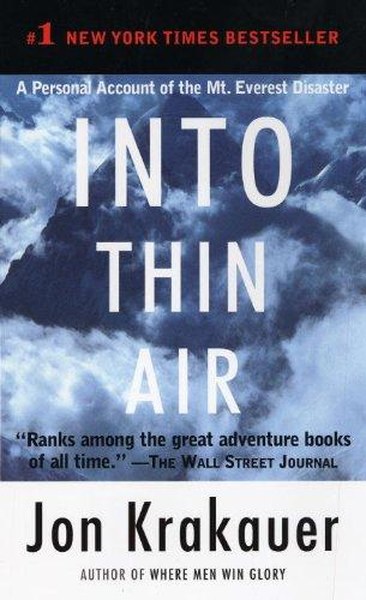
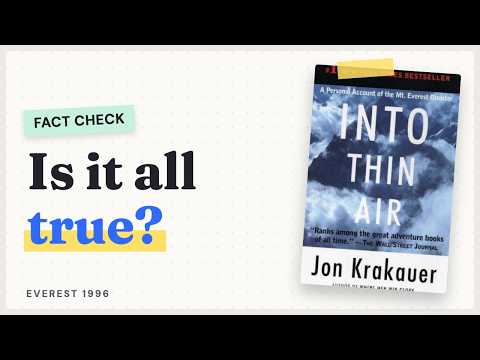
Into Thin Air is a true account, so the question isn’t whether it happened. It’s which parts are solid, which are disputed, and what we’ve learned since.
I checked claims against the book and at least one other source, and I’ll mark anything as disputed or reported. The short version: the broad outline is well documented, and the arguments are mostly about judgment. A note: this video discusses real deaths, and I’ll be careful.
Who Was On The Mountain
Per Krakauer, Hall and Fischer each charged sixty-five thousand dollars a client, and guides were paid from about ten thousand to twenty-five thousand dollars. Nepal’s permit for a team of up to seven climbers had risen from twenty-three hundred dollars in nineteen ninety-one to seventy thousand in spring nineteen ninety-six.
I could only check those figures in the book, so treat them as Krakauer’s reporting. What isn’t in doubt is the trend: a mountain once reserved for elite climbers had become a market.
The Season
By Krakauer’s count, thirty expeditions were on Everest in the spring of nineteen ninety-six, and three hundred ninety-eight climbers went above Base Camp. Twelve people died that season, and eighty-four reached the summit.
Those numbers hold up. National Geographic’s May twenty twenty-six interview with Krakauer repeats that eight climbers died on the night of May tenth, and twelve on the mountain that season. Wikipedia’s account agrees, and lists the other four deaths as unrelated to the storm.
The Eight
The storm of May tenth and eleventh killed eight people. On the south side: Rob Hall, Andy Harris, Doug Hansen, Yasuko Namba and Scott Fischer. On the Tibetan side, three climbers from an Indian police expedition: Tsewang Smanla, Tsewang Paljor and Dorje Morup.
The Indian climbers’ story is the least well known, partly because Krakauer reconstructs it from other people. He says they believed they had reached the summit, but were about five hundred feet short.
The Thin Air
Krakauer says the summit has only a third as much oxygen as sea level. That’s a good shorthand, though it’s the air pressure that falls, not the percentage of oxygen. At the summit, pressure is a bit under a third of the sea-level value.
He also places the Death Zone above twenty-five thousand feet. The usual definition is eight thousand meters, about twenty-six thousand two hundred fifty feet. Either way, the body cannot acclimatize there, which is why every hour counts.
The Turn-Around Time
Hall told his clients to pick a hard deadline and obey it. But Krakauer says he never said which one, one o’clock or two, and many summiteers arrived after two. Wikipedia says some sources give two, others one.
Does timing matter? Yes. A two thousand eight study in the British Medical Journal, by Firth and colleagues, looked at deaths on Everest through two thousand six. Climbers who died generally reached the summit later in the day than survivors did, and more than half of the deaths above eight thousand meters happened on the way down.
The Ropes
Krakauer says the plan to fix ropes ahead of the clients fell apart, and he describes teams waiting around an hour at a rock step, and again below the Hillary Step. Wikipedia’s summary of later analyses puts the lost time at about two hours, with thirty-three climbers on the route.
That figure is reported, not exact. But the broad point is shared by everyone: too many people on one rope, with a clock running, is a recipe for trouble.
Oxygen Supplies
The book says Hall’s clients carried two bottles each, with a third cached on the South Summit, and the gas would run out by late afternoon. Krakauer reports that Andy Harris insisted the cached bottles were empty, when at least six were full.
Neal Beidleman later suggested that a frozen regulator could have misled Harris. That is a theory, not a proven fact. What isn’t disputed is that the confusion cost precious time while Hall and Doug Hansen were stuck near the top.
The Weather
Was the storm unusual? Krakauer calls it a fairly typical Everest squall. But researchers Kent Moore and John Semple concluded that a drop in air pressure that day reduced climbers’ oxygen intake by about fourteen percent, a lot at that height. Wikipedia and Science News both report the study.
There is also a disputed claim. British authors, including Graham Ratcliffe, say teams had accurate forecasts. Krakauer told Slate in May twenty twenty-six that nobody on the mountain knew about them.
The Oxygen Argument
Anatoli Boukreev guided without bottled oxygen, and went down ahead of his clients. Krakauer criticized this in the book, and Boukreev answered in The Climb, written with G. Weston DeWalt, in nineteen ninety-seven. The facts that Boukreev did not use oxygen and descended early are not disputed.
What is disputed is why. Boukreev’s side says Fischer approved it. Krakauer says he found no evidence for a plan, and reports that Reinhold Messner told him no one should guide Everest without oxygen. Both sides agree that Boukreev’s rescue on the Col was heroic.
Krakauer’s Own Mistake
In the first version of his story, Krakauer wrote that Andy Harris had died walking off the edge of the South Col. He later discovered he had mistaken another climber, Martin Adams, for Harris. He says this caused real pain to Harris’s family, and he corrected it.
This is one of the most honest parts of the book. National Geographic’s twenty twenty-six interview shows he still treats it seriously. He says he has made corrections in nineteen ninety-nine and for the thirtieth anniversary edition.
Beck Weathers
Beck Weathers was left on the South Col, believed to be beyond saving. He woke, walked into camp on May eleventh, and, with help from other teams, was evacuated by a Nepalese army helicopter on May thirteenth. This is documented in the book and in Wikipedia.
Weathers lost his right arm below the elbow and the fingers of his left hand, his nose was rebuilt, and he told his own story in a memoir, Left for Dead, in two thousand.
The Hillary Step
Krakauer describes the Hillary Step as a forty-foot rock step near the summit, climbed by Hillary in nineteen fifty-three. In twenty seventeen, climber Tim Mosedale reported that the step had collapsed, likely in the two thousand fifteen earthquake. Nepal’s government disputed the claim, and the cause remains unconfirmed.
Another number changed. The book gives Everest’s height as twenty-nine thousand twenty-eight feet. In December twenty twenty, China and Nepal announced eight thousand eight hundred forty-eight point eight six meters, about twenty-nine thousand thirty-two feet.
Was It A Normal Year?
Krakauer argues in his last chapter that nineteen ninety-six was not unusual statistically: twelve deaths among three hundred ninety-eight climbers is about three percent, close to the historical rate. He also says that before nineteen ninety-six, roughly one climber died for every four who summited.
Since then the mountain has changed. In his National Geographic interview, he gives newer figures: about one death for every five summits through nineteen ninety-six, and about one for every sixty-eight from nineteen ninety-seven through twenty twenty-five. Slate reports that last year’s five deaths were the lowest rate ever. That is a reason to read the book as history, not a forecast.
The Sherpas Then And Now
The book says Sherpas account for more than a third of Everest deaths, fifty-three by nineteen ninety-six. Two later events show how much that burden has continued. In April twenty fourteen, an avalanche in the Khumbu Icefall killed sixteen Nepali workers. In April twenty fifteen, an earthquake avalanche at Base Camp killed twenty-two.
Krakauer said in twenty twenty-six that most guiding firms are now Sherpa-owned, and warned that a mass-casualty event in the Icefall remains the big danger.
The Movie
The two thousand fifteen film Everest, directed by Baltasar Kormákur, opened the Venice Film Festival on September second, and, as of October twenty twenty-six, has earned about two hundred million dollars, according to Box Office Mojo and The Numbers. It stars Jason Clarke as Hall, Jake Gyllenhaal as Fischer, Josh Brolin as Weathers, and Michael Kelly as Krakauer.
Kormákur has said the film is not based on Into Thin Air. Krakauer criticized it publicly, reportedly said one scene never happened, and said anyone wanting a fact-based account should read his book. His version is, of course, also one account.
What We Cannot Know
Some answers are simply gone. Krakauer says nobody knows how Andy Harris died, and that what happened to Doug Hansen on the ridge is conjecture, based on an ice ax found near the South Summit. He calls his own reconstruction speculative.
Rob Hall’s body was found on May twenty-third by the IMAX climbers Ed Viesturs and David Breashears. Per Wikipedia, Hansen’s and Harris’s bodies have never been found. That is a limit, and an honest one.
My Verdict
So how true is the book? Its facts are largely holding up, and the author is unusually open about errors. But the biggest arguments, about oxygen, rivals and rules, are about judgment, and reasonable people still disagree.
If this helped, my full review and a summary are on the channel. Have I missed a fact you want checked? Tell me in the comments, and subscribe for more.