Before We Start
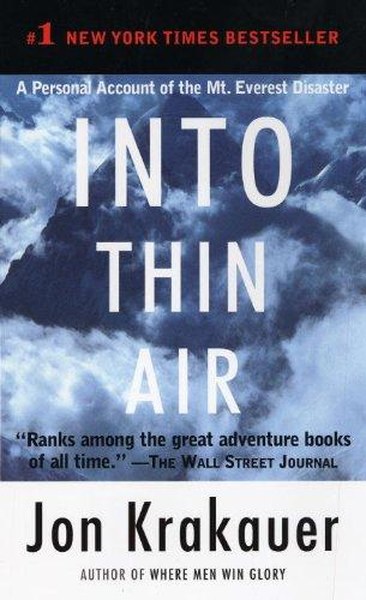
If you’ve ever wondered what really happened on Mount Everest in May of nineteen ninety-six, today I’ll walk you through Jon Krakauer’s Into Thin Air, step by step, in the order it happened.
A warning first. This is a true story, and this summary covers all of it, including who died. It deals with death, frostbite and grief, so take care of yourself. I’ll treat the people in it with respect, and where accounts disagree, I’ll say so.
The Assignment
In March of nineteen ninety-six, Outside magazine sent Jon Krakauer to Nepal to climb Everest with a guided team and write about the commercialization of the mountain. He joined Adventure Consultants, led by the New Zealander Rob Hall, who charged sixty-five thousand dollars a client.
On March twenty-ninth he flew into Kathmandu. The team had three guides, Hall, Mike Groom and Andy Harris, and eight clients, among them a postal worker named Doug Hansen, a Dallas pathologist named Beck Weathers, and a Japanese executive named Yasuko Namba.
The Mountain And Its Story
Krakauer gives the history first. A survey in eighteen fifty-two measured Everest as the highest mountain on earth. In nineteen twenty-four, George Mallory and Andrew Irvine vanished near the top, and nobody is sure whether they reached it. In nineteen fifty-three, Edmund Hillary and Tenzing Norgay made the first ascent.
Then came the shift. In nineteen eighty-five a wealthy amateur, Dick Bass, was guided to the summit, and a business was born. By the spring of nineteen ninety-six, thirty expeditions were on the mountain, and at least ten were run for money.
The Rivals And The Crowd
The other big guide on the mountain was Scott Fischer, an American whose company, Mountain Madness, had never guided Everest before. He and Hall were friendly rivals. Fischer’s team included the Russian guide Anatoli Boukreev, a guide named Neal Beidleman, and the socialite Sandy Hill Pittman.
Around them were other teams, some far less experienced, among them a Taiwanese team and a South African one. Hall worried out loud that one of them would blunder into trouble and force everyone else to help.
The Trek And Base Camp
On March thirty-first, Hall’s team flew by helicopter to Lukla and began walking up the Khumbu valley, through Namche Bazaar, Tengboche, Pheriche and Lobuche. Krakauer describes the Sherpa villages, the monasteries, the thin air, and the cough he picked up that would last the whole trip.
In April they reached Base Camp, a town of tents on a river of ice. Hall’s plan was to adapt their bodies with trips to Camp One, Two and Three, then rest. A Sherpa on Fischer’s team, Ngawang Topche, fell gravely ill with pulmonary edema that month and did not recover.
The Icefall
The first big hazard is the Khumbu Icefall, a moving glacier broken into huge ice towers. Krakauer says each trip through it was like a round of Russian roulette. Sherpas had laid about sixty aluminum ladders and a mile of rope through it, and clients clipped on and crossed chasms on rungs.
He was terrified of it every time. But the real danger, he came to see, was higher up, where the body begins to fail.
Oxygen And The Death Zone
Above twenty-five thousand feet lies what climbers call the Death Zone, where the body slowly breaks down. Most climbers there breathe bottled oxygen, an old argument: Mallory first called it unsporting, and in nineteen seventy-eight Reinhold Messner and Peter Habeler reached the top without it.
On summit day, each of Hall’s clients carried two bottles, which would last five or six hours each, and a third waited on the South Summit. By late afternoon, everyone’s gas would be gone.
The Plan For Summit Day
Hall picked May tenth as summit day. He lectured his clients about a turn-around time, one o’clock or two at the latest, because the trick, he said, is to get back down alive. On May ninth, a climber from the Taiwanese team, Chen Yu-Nan, died after a fall, and the teams moved up to the South Col.
Hall’s Sherpas had stocked only enough oxygen for a single attempt. That night a gale blew. Around seven thirty it stopped, and Hall called that they were on. At eleven thirty-five, thirty-four climbers set out for the top.
The Climb Up
It was a freezing, clear night. Hall’s clients had to wait for the group, and some stepped out of line, including Frank Fischbeck, who turned around early. Most climbers used bottled oxygen. Boukreev, and Fischer’s Sherpa leader Lopsang Jangbu, did not.
A plan to fix ropes ahead of time did not happen, and the teams backed up at the steep rock steps and again below the summit, where the Hillary Step, a forty-foot notch in the ridge, let only one climber pass at a time. Around eleven thirty in the morning, three of Hall’s clients turned back. Krakauer reached the top at one twelve, and left five minutes later.
The Summit
A few climbers arrived before the two o’clock turn-around time. Most did not. Neal Beidleman reached the top at one twenty-five, and Sandy Pittman at about ten past two. Hall, Mike Groom and Yasuko Namba arrived around then, and Hall radioed the good news to Base Camp.
Fischer reached the summit at about three forty. Doug Hansen, whom Hall was waiting for, arrived around four, two hours past the turn-around. According to Lopsang Jangbu, Hall helped him up the last stretch. Then clouds began to cover the peaks.
The Storm
As Krakauer went down, he found Beck Weathers waiting at the Balcony, where Hall had told him to stay. He kept going, ran out of oxygen, and reached the tents after dark, as a blizzard became a full hurricane.
Beidleman, Groom and several clients were lost on the Col, about a thousand feet from camp. They huddled for hours. Around midnight, Beidleman and a few others went for help, and Tim Madsen stayed with the four who could not walk.
The Rescue On The Col
Anatoli Boukreev, who had come down early, went out into the storm and brought back Sandy Pittman, Charlotte Fox and Tim Madsen. Krakauer, who criticizes some of Boukreev’s earlier choices, calls this a heroic act.
The next morning, Stuart Hutchison found Yasuko Namba and Beck Weathers still breathing. In an agonizing decision, the climbers present judged that they could not be saved. Namba died. Andy Harris was missing too, and Krakauer later learned that he had mistaken another climber for Harris.
Rob Hall’s Last Day
Near the top of the Hillary Step, Hansen had run out of strength and oxygen. Hall radioed for gas, but a confused Andy Harris told him the bottles at the South Summit were empty, though full ones were there. Hall stayed with his client.
High on the South Summit the next morning, Hall was alive but stuck, and Doug Hansen was gone. Through May eleventh, friends begged him over the radio to come down, and two Sherpas tried to reach him but were turned back by wind. That evening he spoke to his wife, Jan Arnold, in New Zealand, and told her he loved her. They were the last words anyone heard from him.
Scott Fischer had also stayed on the ridge. Sherpas reached him, but they could not save him, and Boukreev later found that he had died.
Beck Weathers
On the afternoon of May eleventh, something astonishing happened. Beck Weathers, who had been left for dead, woke up, and walked into camp with severe frostbite. He nearly died again that night, but the next day climbers from other teams helped him down.
On May thirteenth, a Nepalese army helicopter landed in the Western Cwm and flew him out. He lost his right arm below the elbow and the fingers of his left hand, and his nose had to be rebuilt, but he lived.
The Other Side
There was a second tragedy on the Tibetan side. Three Indian climbers who thought they had reached the summit on May tenth died in the same storm. In all, twelve people died on Everest that spring, eight of them in this storm.
Later that month, Bruce Herrod of the South African team was lost after a late summit. In September, Lopsang Jangbu died in an avalanche, and in December of nineteen ninety-seven, Boukreev died on Annapurna.
What Krakauer Concludes
Krakauer does not give one neat answer. He points to the turn-around time that was ignored, the delays at the ropes, the rivalry between the guides, and how hard it is to think at that altitude. He also blames himself, and says he is still haunted.
He doubts that rules can fix it, because the system is loosely regulated and climbers will always take risks. He adds a long postscript on a rival account, The Climb, by Boukreev and G. Weston DeWalt, which disputes parts of his version.
Where To Go Next
That’s the story. If you want to dig deeper, I made a fact check on the real history, a books like it video, and a full review. Have you read Into Thin Air? Tell me what stayed with you, and subscribe if you want more clear, honest summaries.