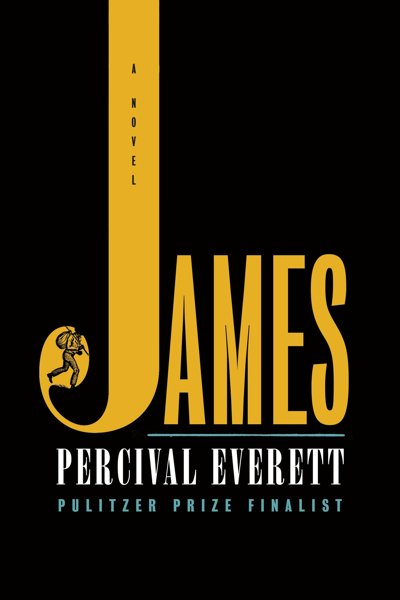
The Verdict
So, is it worth reading? Yes, with a serious warning. It is smart, funny, furious and gripping, and it has one of the best narrative voices I’ve read in years. But it is also brutal, and it uses a racial slur and shows violence throughout.
I give it four out of five. The voice is a five, while the pacing and some of the supporting cast are weaker. This review is spoiler free, which means no late reveals, no deaths and no twists.
What It Is About
James retells Adventures of Huckleberry Finn from the point of view of Jim, the enslaved man on the raft. The year is some time before the Civil War, the place is Hannibal, Missouri, and Jim is a husband and father, owned by a woman named Miss Watson.
Early on, he learns that she plans to sell him to a man in New Orleans. That would separate him from his wife, Sadie, and his daughter, Lizzie. So he runs, and hides on Jackson Island in the Mississippi, where he meets Huck, who is hiding too.
From there the book becomes a journey down the river, with the same chance meetings and close calls you may remember, though Everett has his own plans for where Jim ends up. I won’t say where.
Do You Need Huck Finn
Do you need to have read Twain first? No. Everything you need is on the page, and I enjoyed the book most when I stopped checking it against the original.
That said, knowing Twain adds a layer. Twain published his novel in the eighteen eighties, and he told it through Huck’s eyes. Jim was a kind, loyal and sometimes comic figure seen from the outside. Everett keeps the events recognizable and changes who is allowed to think.
If you read Twain at school and remember Jim as a sidekick, this book is a sharp, deliberate answer. If you have never read Twain, it works as a stand-alone adventure.
The Voice
The best thing here is the voice, and it’s really two voices. When Jim talks to white people, he speaks the way they expect enslaved people to speak. When he is alone, or with his own people, or writing, he speaks in complete, educated, ironic sentences. In the first chapter, two boys hide in the grass to scare him, and Jim spots them at once, then plays along, because it pays to give white people what they want.
Chapter two is where this clicks. Jim runs a language lesson for the children in the quarters, with rules for staying alive, and it is funny and heartbreaking at once. He even calls it the correct incorrect grammar.
That idea of language as armor and as disguise carries the whole novel. Watching Jim switch voices, sometimes in the middle of a sentence, is thrilling, because every switch carries risk.
Jim And Huck
The relationship with Huck is the second pillar. In the opening chapters Huck is a lonely, curious boy who confides in Jim, because Jim is the one grown-up who listens. Jim, for his part, knows exactly how much a white child can understand, and how much he must hide.
Their conversations are delicate. Huck asks innocent questions about owning people, and Jim answers them in the slave voice, with irony tucked underneath. I found these exchanges among the best in the book, because both of them are being honest, and neither one can say it all.
Their friendship feels real without ever becoming sentimental. Everett never lets the reader forget that Jim carries the risk and Huck carries none.
The River
The Mississippi is practically a character. It is beautiful, and it is also murderous. There are storms that arrive from nowhere, fog that hides steamboats, wakes that tear rafts apart, and a flood that changes the map overnight.
Everett writes it with plain, physical detail. You learn how to run a trotline, how to start a fire with a piece of glass, and how a runaway reads birds and weather to stay alive. That grounded survival writing gives the philosophical scenes something solid to stand on.
The river is also where the book’s central idea lives: freedom is a direction, but the current is rarely going your way.
Ideas And Humor
Jim has read in secret, in a judge’s library, and in his fever dreams he argues with Enlightenment thinkers like Voltaire and Locke about freedom and slavery. These scenes are some of the cleverest in the book, and they are also biting, because the philosophers’ fine words never stretch quite far enough to cover him.
The book is also genuinely funny. There is a lot of wordplay, dry jokes about irony and grammar, and absurd set pieces. Humor is how Jim survives, and it also makes the dark scenes land harder, because you’ve been laughing with him.
There’s an ongoing meditation on names, on who gets to tell a story, and on what it means to write yourself into being. It never feels like homework, because it is always attached to a person in danger.
Content Warnings
Now the content warnings, because they matter. I would rather you know before you start than be caught off guard. The book uses a racial slur many times in dialogue, as the white characters of that era would. It does so deliberately, but it is on the page.
You will also meet whippings, hangings, murder, gunfire and the threat of lynching, and violence that falls on children. There are references to sexual violence, and the book doesn’t look away from the cruelty of the system.
It never feels gratuitous to me, and it is never presented as entertainment. But if you are in a fragile place, or you need a break from racist violence in fiction, consider waiting or reading it in pieces.
The Writing
The prose is lean, dry and exact. Everett rarely decorates a sentence. He lets a plain observation do the work, and then he adds a single sly twist, usually a joke, that changes what you’ve just read.
Sentences about waiting, about hunger, about the weight of a book in your hands, are written with real patience. Then a scene of violence arrives in short, flat lines that hit harder than any ornament could.
If you like writers who trust the reader, such as Colson Whitehead, this will feel familiar. If you want lush description, you may find it spare. I found the restraint powerful, and it makes the occasional burst of lyrical writing about the river feel earned.
Structure And Pacing
James is about sixty-six thousand words, split into fifty-three short chapters across three parts. That makes it quick. Many chapters are only a few pages, and the structure rewards a read in long sittings.
The book keeps changing shape. It starts like a river adventure, takes some sharp turns in the middle, and the final stretch moves like a thriller. I loved how the story never repeats its mood for long.
The tradeoff is that the second half doesn’t have the same slow, rich texture as the first. A couple of stretches feel rushed, as if the plot is running to catch up with the ideas.
What Works
Let me name three strengths. First, the narrator. Jim’s inner life is the book, and Everett gives him humor, rage, love and a mind of his own, without ever making him a symbol.
Second, the set pieces. A con-artist revival meeting, a flooded house, a night on the river: each scene has its own mood, and several are among the most memorable I’ve read this year.
Third, the emotional engine. Jim is not trying to save the world. He’s trying to get to his family, and that simple goal keeps even the strangest stretches human.
What Doesn’t
Now some honest criticism, and this part is opinion. First, convenience. Characters from earlier in the story turn up again and again, at the exact moment the plot needs them, and it’s hard to believe in every coincidence.
Second, several supporting characters exist to serve a theme. They are vivid for a chapter, but few become people you’d miss.
Third, the debates with the philosophers can read like lectures, and the last third gets more direct and less subtle than the first. None of that sank the book for me, but it keeps it from a perfect score.
Awards And The Movie
Some context, as of October twenty twenty six. James won the National Book Award for Fiction in twenty twenty four and the Pulitzer Prize for Fiction in twenty twenty five.
A film is also in the works. Universal reportedly acquired the rights in June twenty twenty four, with Steven Spielberg’s company, Amblin, producing and Everett writing the script. Taika Waititi was reported to be directing. I could not find a cast or release date.
The Scorecard
Time for the scorecard, out of five. For voice, five out of five. It is the reason to read the book.
Ideas get four and a half. Suspense gets four, and characters get three and a half. Pacing gets three.
That averages to four, so James lands at four out of five. It’s not flawless, but it’s fearless, and it changed how I think about a book I thought I already knew.
Who It’s For
Read it if you like voice-driven historical fiction. Read it if you remember Huckleberry Finn and wondered what Jim was thinking. Read it if you want a book that is funny, angry and moving, in short chapters.
Skip it if graphic racial violence is too much right now. Skip it if you want a gentle adventure. And skip it if you need every supporting character fully rounded.
If you do read it, tell me in the comments: which Jim moment surprised you most? I’d love to hear. If this helped, please like the video and subscribe. The page for James is on bookexplained.com, with every link.