Intro
If you just finished The Psychology of Money, by Morgan Housel, and you’re wondering what to read next, this video is for you. I’ll give you seven real books, from a gentle follow-up to the classics that Housel himself quotes along the way.
One quick note. These are book recommendations, not financial advice, and every author here is giving their own view. I’ve ordered them roughly from easiest to hardest, so you can start wherever you’re comfortable, and for each one I’ll tell you who it suits best. At the end, we’ll also look at the one idea all seven books share, and how to choose between them. Let’s get started.
Same As Ever
Number one is Same as Ever, by Morgan Housel, from twenty twenty-three. It is his follow-up, and its idea flips the usual question. Instead of predicting what will change, it looks at the things that never do, like human behavior and the way people react to risk.
If you loved Housel’s voice, this is the closest match. It has the same short chapters and the same easy, story driven style. Expect it to be more about life than about money, with fewer portfolios and more people, but the way of thinking will feel instantly familiar.
Who is it for? Fans who finished the first book wanting more. It is also an easy pick for gifts, since the chapters are short and you can start anywhere.
The Millionaire Next Door
Number two is The Millionaire Next Door, by Thomas Stanley and William Danko, from nineteen ninety-six. The authors studied American millionaires and found that many of them lived quietly, in ordinary homes, driving ordinary cars, and spending far less than their income allowed.
That connects straight to Housel’s chapter on wealth being what you don’t see, and Ronald Read would have fit right in. It is more data driven than Housel, and its numbers are older now. But the central idea, that real wealth is usually built quietly, still holds up well.
Who is it for? Anyone who enjoyed the janitor story and wants to ask how common that pattern really is. Read it alongside Housel’s idea that saving is the gap between ego and income, and you will start noticing spending habits everywhere.
The Intelligent Investor
Number three is The Intelligent Investor, by Benjamin Graham, from nineteen forty-nine. It is the classic on value investing, and it gave the world the idea of margin of safety, the same idea Housel leans on in his chapter about room for error.
Housel calls the book full of wisdom, but questionable as a how to guide, because Graham kept revising his own formulas as the world changed. So read it for the mindset, not the recipes. Be warned that it is dense and reads like a textbook, so it is a real step up in difficulty.
Who is it for? Readers who finished Housel curious about where his investing ideas come from. Pair it with his chapter on surprise, where he explains why a great investor’s formulas stop working, and you get both the classic and the caution.
The Little Book Of Common Sense Investing
Number four is The Little Book of Common Sense Investing, by John Bogle, from two thousand seven. Bogle founded Vanguard, and he makes the case for owning low cost index funds and holding them for the long run. Housel quotes him in the chapter on enough.
It is short, clear and one sided, and that is its strength. If The Psychology of Money left you asking what you would actually buy, this book gives one very direct answer. Remember that it is one view, and not a recommendation for you personally.
Who is it for? Anyone who likes short books with a clear argument. It also pairs well with Housel’s confessions chapter, where he describes why he holds index funds himself, so you can compare both explanations.
The Simple Path To Wealth
Number five is The Simple Path to Wealth, by J. L. Collins, from twenty sixteen. It is a friendly, plain spoken guide to saving, avoiding debt and investing in index funds, written for readers who are not finance experts and do not want to become one.
Where Housel gives you ideas about behavior, Collins gives you a step by step approach. They agree on a great deal, including patience and keeping things simple. Think of it as a good second book after the first one. And again, it is one person’s opinion, so weigh it for yourself.
Who is it for? Beginners who liked the ideas but want a clear starting point. Because it is so direct, it works as a counterweight to the more reflective tone of Housel, who says openly that he cannot tell you what to do.
Fooled By Randomness
Number six is Fooled by Randomness, by Nassim Nicholas Taleb, from two thousand one. It is about how we mistake luck for skill, and about preparing for the unexpected. Housel quotes it in his chapter on surprise, when he explains why the worst past event is not the worst possible one.
It is sharper, more argumentative and more philosophical than Housel. Taleb can be prickly, and the book does not hold your hand. But if the chapters on luck, risk and rare events grabbed you, this is where those ideas get their full workout.
Who is it for? Readers who want to go deeper on risk and the unexpected. Pair it with Housel’s chapter on luck and risk, and the story of Bill Gates and Kent Evans, to see the same idea from a more skeptical angle.
Thinking, Fast And Slow
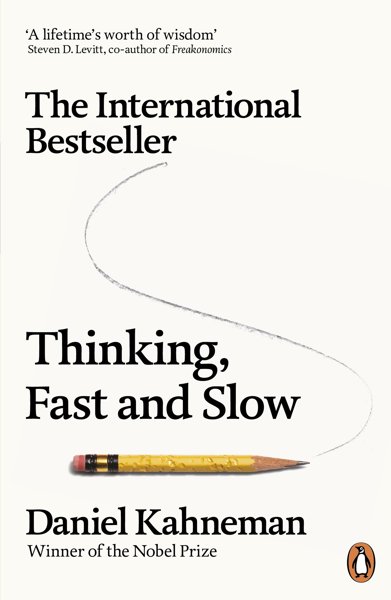
Number seven is Thinking, Fast and Slow, by Daniel Kahneman, from twenty eleven. Housel quotes Kahneman again and again, including on hindsight and on how losses feel bigger than gains. In many ways it is the research that sits underneath his book.
It is long, dense and demanding, and it is about decisions in general, not only money. But it is the best way to understand why people behave the way Housel describes. I have a full review, a summary and a lessons video on the channel if you want a way in.
Who is it for? Patient readers who want to know why people behave the way they do. Take it slowly, one part at a time, and you will start spotting the biases Housel describes in your own decisions.
What They Share
Look across all seven, and a pattern appears. None of them says the answer is a secret formula. They talk about time, humility and survival. They say that unpredictable things happen, that luck matters more than we admit, and that staying calm is worth more than being clever.
That is exactly the thread that runs through Housel’s book. So whichever one you pick, you are not changing the subject. You are following the same idea into a different room, with a different guide.
Where To Start
So which one first? If you want more of the same voice, pick Same as Ever. If you want to understand investing choices, try The Little Book of Common Sense Investing or The Simple Path to Wealth. If you want the psychology under it all, go to Kahneman.
If you only have time for a short reading plan, try this. Start with Same as Ever for the voice, then pick one practical book, either Bogle or Collins, and finish with Kahneman or Taleb when you want to go deeper. That way you get comfort, a framework and a challenge, in that order.
Links to all seven are in the description below. Tell me in the comments which one you will read first, and thanks for watching.