📝 Summary · Summary
Thinking, Fast and Slow Summary: The Big Ideas Explained
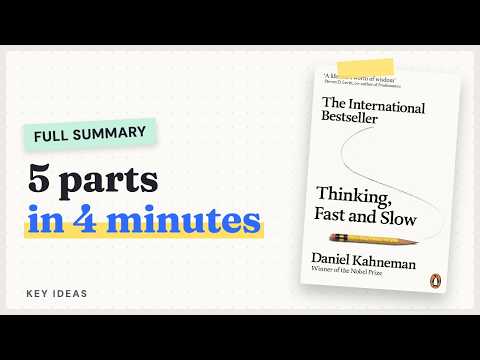
A summary of Thinking, Fast and Slow by Daniel Kahneman, part by part: two systems, anchoring, overconfidence, loss aversion and the two selves.
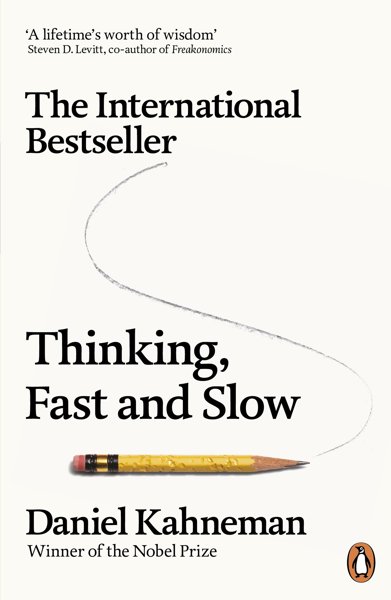
A Nobel laureate explains the two systems of the mind, one fast and intuitive, one slow and careful, and why the fast one makes predictable mistakes.
A landmark book that will change how you think about your own decisions, held back by length, density and some research that has been questioned since. Four out of five.
Every guide comes as a video and a full written article. Pick the one you need: the review is spoiler-free, the ending explained is not.
A summary of Thinking, Fast and Slow by Daniel Kahneman, part by part: two systems, anchoring, overconfidence, loss aversion and the two selves.
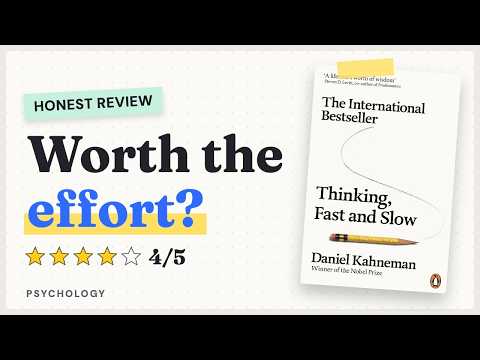
Is Daniel Kahneman's Thinking, Fast and Slow worth the effort? An honest, spoiler-free review: System 1 and System 2, what works, what doesn't and my score.

Six practical habits from Thinking, Fast and Slow: slow down, ask what is missing, beware of anchors, use the outside view and more.

Loved Thinking, Fast and Slow? Six books to read next: Nudge, Predictably Irrational, Misbehaving, The Black Swan, Noise and Blink.
Thinking, Fast and Slow is Daniel Kahneman’s 2011 book on how we think and decide. Kahneman won the Nobel Prize in Economics in 2002 for the research he did, much of it with Amos Tversky, and here he gathers it into five parts and thirty-eight chapters.
Below you’ll find a review, a summary of the big ideas, six practical habits and six books to read next.
Kahneman won the Nobel Prize in Economics in two thousand two for work he did with his friend Amos Tversky. This book brings together decades of that research into one story.
The central idea is that your mind has two modes. System one is fast, automatic, and intuitive. System two is slow, effortful, and logical. Most of the time, system one runs the show, and it is wrong in predictable ways.
The book has five parts, thirty eight chapters, and almost two hundred thousand words, so it is a long read.
Kahneman won the Nobel Prize in Economics in two thousand two for work he did with his friend Amos Tversky. This book brings together decades of that research into one story.
A landmark book that will change how you think about your own decisions, held back by length, density and some research that has been questioned since. Four out of five. Read it if: you are curious about decisions, money or psychology; you enjoy puzzles that show your own mind at work; you are willing to read slowly. Skip it if: you want a quick, light read; you want a step-by-step self-help guide; you dislike dense, example-heavy chapters. Review: Thinking, Fast and Slow →
A summary of Thinking, Fast and Slow by Daniel Kahneman, part by part: two systems, anchoring, overconfidence, loss aversion and the two selves. Summary: Thinking, Fast and Slow →
Nudge by Richard H. Thaler and Cass R. Sunstein, Predictably Irrational by Dan Ariely, Misbehaving by Richard H. Thaler, The Black Swan by Nassim Nicholas Taleb, Noise by Daniel Kahneman, Olivier Sibony and Cass R. Sunstein, Blink by Malcolm Gladwell. Books like it: Thinking, Fast and Slow →
System 1 is the fast, automatic, intuitive mode of thinking. System 2 is the slow, effortful, logical mode. Kahneman argues that System 1 runs most of the time and is wrong in predictable ways.
A bat and ball cost $1.10 and the bat costs one dollar more than the ball. The intuitive answer is 10 cents, but the correct answer is 5 cents.
The core ideas on heuristics and loss aversion are widely used, but some findings in the book, especially on priming, have been challenged in replication efforts. This is the reviewer's summary, not a formal assessment.
Amazon links. We may earn a commission if you buy through them.