The Short Version
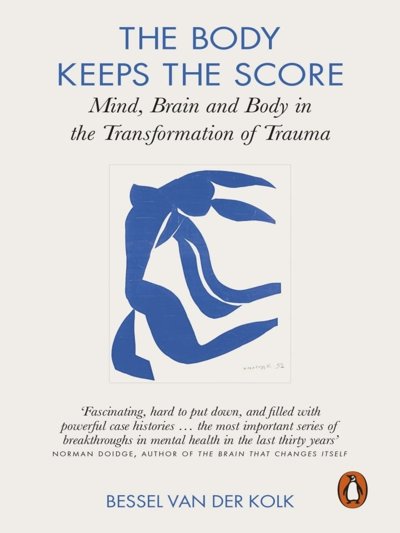
The Body Keeps the Score (2014), by psychiatrist Bessel van der Kolk, argues that trauma reshapes how the brain detects danger and how people experience their bodies, and surveys treatments from EMDR to yoga. It is part memoir, part science book, part clinical casebook and part guide to treatments, about four hundred and fifty pages in twenty chapters. It suits a book club because many readers say it gave them a language for feeling numb, jumpy or disconnected, and because researchers have pushed back on parts of its science.
Our review scores it four out of five: important and often moving, but long, uneven and stronger in its claims than the evidence. Read it as one influential perspective. This guide is a set of discussion questions about a book, not medical advice. If you or someone in your group is struggling, please reach out to a professional or someone you trust.
Before You Start: Content Notes For Your Group
The book includes detailed accounts of abuse, including childhood sexual abuse and violence. Some readers find it overwhelming, especially when reading about their own experiences. Tell your group first, agree that people can step out of the conversation, and share only what you are comfortable sharing.
Discussion Questions
- The book opens with Tom, a Vietnam veteran van der Kolk met on his first day at the Boston Veterans Administration Clinic in 1978, who could not feel affection for his wife. Why does the author begin with a single patient?
- Van der Kolk writes that one in five Americans was sexually molested as a child and one in four was beaten hard enough to leave a mark. How did those figures change your sense of how common trauma is?
- The amygdala is a smoke detector, and the prefrontal cortex is a watchtower. Did the metaphor help you understand your own reactions, or did it oversimplify?
- In one brain-scan study, a speech area called Broca’s area went quiet during flashbacks. Our science check calls the study real but small. How much should a general reader trust a single early study?
- Many traumatized people, he writes, feel numb or cut off from their bodies. What does it mean to feel safe in your own body?
- The title suggests trauma is held in the body. Our science page says the idea that memories are literally stored in muscles is not supported, and is better understood as a metaphor. Does the title still work for you?
- The Adverse Childhood Experiences study asked more than seventeen thousand patients about ten kinds of childhood adversity, and higher scores were linked to worse health later. Why does our science check say this part of the book holds up well?
- Van der Kolk argues that diagnoses like ADHD or bipolar disorder are sometimes given when the underlying problem is trauma. What do you make of that, and of his unsuccessful campaign for developmental trauma disorder?
- The book discusses memories forgotten and later recovered. Critics say it leans too far toward accepting recovered memories as accurate. How should a book handle such a contested area?
- The treatment chapters cover EMDR, trauma-sensitive yoga, internal family systems therapy, psychomotor therapy, neurofeedback and theater programs. Which surprised you most, and which would you want evidence for first?
- Our science page says the book says less than you might expect about trauma-focused talk therapies, which have some of the strongest research behind them. Does that change how you read the treatment section?
- In 2018 van der Kolk was removed as medical director of the Trauma Center he founded after allegations of a hostile work environment, which he denied. Does an author’s conduct change how you read a book?
Applying It
Take the treatment chapters as a map of options to discuss with a qualified professional, not as a prescription. If your group wants to follow up, ask what the evidence says for each approach before trying it. Our science page suggests asking about therapies with strong evidence, such as trauma-focused cognitive behavioral therapy, cognitive processing therapy, prolonged exposure or EMDR.
What Holds Up
Our science check separates the book’s claims. That trauma is common and affects the nervous system, not just memories, is widely accepted. The smoke detector and watchtower image is a reasonable simplification, though brain-imaging studies of trauma are often small. The claim that memories are literally stored in the body, and the confident handling of recovered memories, are the most contested. The best-known critic is Michael Scheeringa, a child psychiatrist at Tulane University.
What To Read Next
Our review lays out which chapters to sample if you do not want to read all four hundred and fifty pages, and recommends reading slowly. Our summary page covers the big ideas, and our science check covers what holds up. The books-like-it list points to similar reads, including more skeptical ones for balance.