The Short Version
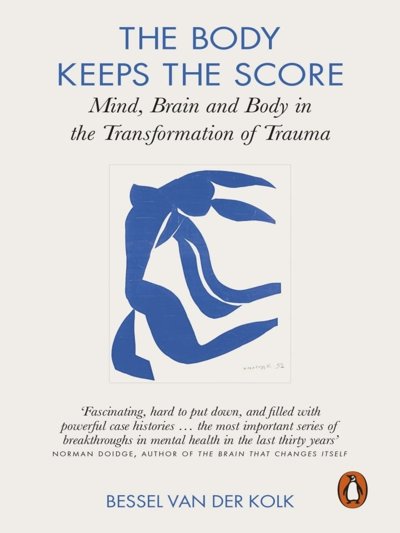
The Body Keeps the Score is one of the most influential books about trauma ever written, but in recent years some researchers have pushed back hard on its science. So today I’m checking the book’s biggest claims against the evidence. As always, if this topic is hard for you right now, please look after yourself, and talk to a professional before changing any treatment.
The short answer: the core idea, that trauma affects the body and the nervous system, not just memories, is widely accepted. But several specific claims are stronger than the evidence, and some of the treatments van der Kolk promotes are less proven than the book suggests.
Who’s Criticizing It
The most prominent critic is Michael Scheeringa, a child psychiatrist and trauma researcher at Tulane University. He has written a booklet and a full book examining more than a hundred claims from The Body Keeps the Score.
Other researchers and writers have raised similar concerns. Supporters, on the other hand, credit the book with bringing trauma-informed care into the mainstream. So this is a real scientific debate, not just internet drama.
Claim One: Trauma Is Common
The book opens with statistics: one in five Americans sexually abused as a child, one in four beaten hard enough to leave a mark. These come from survey research, and childhood adversity is genuinely common.
The ACE study, which the book describes in detail, is real and important. More than seventeen thousand Kaiser Permanente patients answered questions about childhood adversity, and higher scores were strongly linked to worse health later in life. This part of the book holds up well, though the ACE study shows associations, not proof that each experience directly causes each outcome.
Claim Two: The Smoke Detector And The Watchtower
The idea that the amygdala acts as a threat detector, and that the prefrontal cortex helps regulate it, is a reasonable simplification of mainstream neuroscience. Many studies of PTSD find differences in how these areas respond.
But brain-imaging studies of trauma are often small, and the findings vary. The metaphor is useful for understanding feelings. It’s not a precise map of what happens in every traumatized brain.
Claim Three: Speechless Terror
The book describes a brain-scan study in which a speech area, Broca’s area, went quiet during flashbacks. That study was real, but it was small, and it was early-generation brain imaging.
The broader idea, that traumatic memories can be hard to put into words, matches what many patients report. The specific brain explanation is less settled than the book implies.
Claim Four: Trauma Is Stored In The Body
This is the title, and it’s where critics push hardest. The book suggests that trauma is somehow held in the body, and that body-based therapies reach it in ways talk can’t.
Most researchers agree that trauma affects the nervous system and stress responses, and people with PTSD often have physical symptoms. But the idea that memories are literally stored in muscles or tissues isn’t supported by evidence. It’s better understood as a metaphor.
Claim Five: Traumatic Memory
The book discusses traumatic memories being stored as fragments and sometimes forgotten for years and then recovered. This is the most contested area.
Memory researchers have shown that memories can be distorted, and that suggestive therapy can create false memories. Many experts are cautious about recovered memories of abuse. The book acknowledges the debate, but critics say it leans too far toward accepting recovered memories as accurate.
Claim Six: Polyvagal Theory
Van der Kolk draws on Stephen Porges’s Polyvagal Theory, which describes three states of the nervous system: social engagement, fight or flight, and shutdown. It’s popular with therapists.
But several neuroscientists dispute key parts of its biology and evolution. The everyday message, that feeling safe with other people calms the body, is sensible. The detailed theory is debated.
Treatments: What The Evidence Says
Now the treatments. EMDR, which the book praises, is recommended by major bodies like the International Society for Traumatic Stress Studies and the World Health Organization for PTSD. But studies generally haven’t shown it to beat other trauma-focused therapies like cognitive processing therapy or prolonged exposure, and whether the eye movements themselves matter is still debated.
Trauma-sensitive yoga has some promising small trials, including one led by van der Kolk’s team. Neurofeedback has weaker evidence. And the book says less than you might expect about trauma-focused talk therapies, which have some of the strongest research behind them.
Why It Still Matters
So, is the book bad science? Not exactly. It’s an influential perspective written by a clinician, mixing solid research with personal experience and some overreach.
Its biggest contribution is cultural. It helped people see trauma as common, physical, and treatable, and it pushed the field to take childhood adversity seriously. Its biggest risk is that readers take every claim as settled fact, or skip proven treatments for unproven ones.
How To Use This Book
My advice. Read it for empathy and big ideas. Check its treatment claims with a qualified professional. And if you’re seeking help for trauma, ask about therapies with strong evidence, like trauma-focused cognitive behavioral therapy, cognitive processing therapy, prolonged exposure, or EMDR.
Your Turn
Did you know about the debate over this book’s science? Tell me in the comments. My summary and review are linked below. Thanks for watching, and take care.