The Short Version
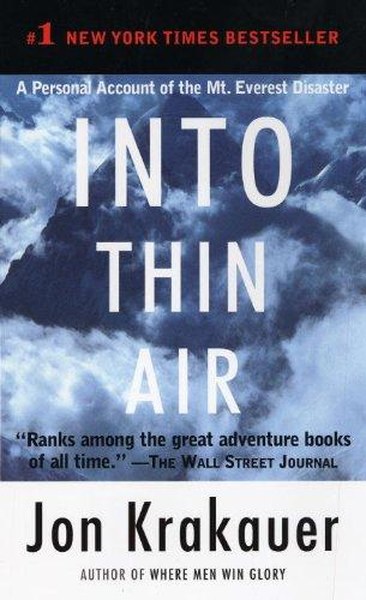
Into Thin Air is Jon Krakauer’s 1997 account of the 1996 Mount Everest disaster. Outside magazine sent him to Nepal to join a guided climb led by Rob Hall and write about the commercialization of the mountain. He reached the summit on May 10, a storm struck while many climbers were still high up, and twelve people died on Everest that season, eight of them in that storm.
It suits a book club because it is gripping, honest about what the author cannot know, and full of decisions your group will disagree about. Our review rates it four and a half out of five. The book runs about 98,000 words in 21 chapters, and a 30th anniversary edition with a new foreword came out in May 2026.
Before You Start: Content Notes For Your Group
The book describes death, severe cold injuries and hypothermia in unflinching detail, along with grief and survivor’s guilt. It has frequent strong language and a brief scene of drug use near the end.
Discussion Questions
- Chapter one drops you on the summit, then the book rewinds to Kathmandu. How did knowing it ends badly change the slow first half?
- Krakauer says at altitude the mind is unreliable. He asked three people to recount something all four had witnessed and none agreed on the time, the words or who was there. How much should we trust any account of the night of May 10?
- He checked stories against radio logs kept at Base Camp, where people could still think clearly. Does that make you trust his reporting more?
- Hall and Fischer charged sixty-five thousand dollars a client, and a permit for a team of up to seven cost seventy thousand dollars in spring 1996. Is it fair to blame the commercialization of the mountain?
- Krakauer felt that Sherpas and guides were doing the climbing for him. Who is responsible for a client’s safety: the client, the guide or the system?
- Hall told his clients to obey a turn-around time of one o’clock or two at the latest, but many reached the summit after two, and Doug Hansen arrived around four. Why did so many people ignore the rule?
- The planned ropes were not fixed, and teams backed up at the rock steps and below the Hillary Step. Is the disaster one bad decision or a pile of small ones?
- Doug Hansen was a postal worker who worked night shifts to pay for the trip. Which of the climbers did the book make you care about most, and why?
- Anatoli Boukreev guided without bottled oxygen and went down ahead of his clients, then rescued Sandy Hill Pittman, Charlotte Fox and Tim Madsen from the storm. Krakauer criticizes one choice and calls the other heroic. Are both judgments fair?
- Boukreev answered in his own book, The Climb, written with G. Weston DeWalt. How should a reader treat a disputed story told by only one climber?
- Beck Weathers was left for dead, woke up and walked into camp. What did that episode say about the limits of the decisions climbers made in the dark?
- Krakauer admits that his first article mistook another climber, Martin Adams, for Andy Harris and hurt Harris’s family. Does that admission make the book more or less credible?
- He calls his own reconstruction of some events speculative. Where did you most want him to say less, or more?
- Krakauer writes openly about survivor’s guilt. Did the book make you sympathize with him, or did it feel like a defense?
Applying It: Decisions Under Pressure
Ask your group to take the disaster off the mountain. When have you kept going past a deadline you set yourself? Hall knew the value of a hard turn-around time and still did not stop Hansen, and Krakauer says nobody ever specified whether it was one or two. What rule would you set before the pressure arrives, and who would have the authority to enforce it? Also compare the roles on the team: the guides who make the calls, the Sherpas who fix the route and carry loads, and the clients who pay. Where in your own work does responsibility blur in the same way?
Facts To Check Together
The Death Zone begins above twenty-five thousand feet, and Krakauer says the summit has about a third of the oxygen of sea level, although what actually falls is air pressure. Thirty expeditions were on the mountain and 398 climbers went above Base Camp that spring. The 2015 film Everest is not based on the book, and Krakauer criticized it. He told National Geographic that deaths per summit are far lower since 1997.
What To Read Next
Start with our review for a spoiler-light verdict. The summary page walks through what happened in order, and the fact check separates solid history from disputed points. Our books-like-it list covers six more true stories for readers who want another account of survival and risk.