The Verdict
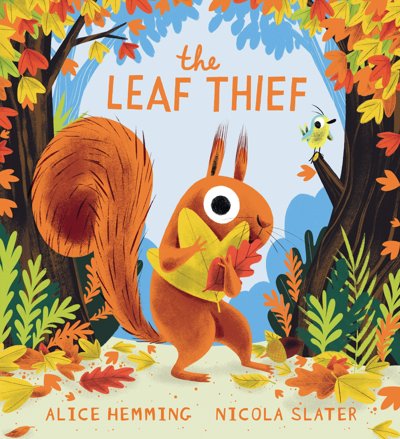
Today’s book is a picture book that pops up in a lot of classrooms every autumn: The Leaf Thief, written by Alice Hemming and illustrated by Nicola Slater.
My verdict: if you read aloud to kids aged about three to seven, get this one. It’s short, genuinely funny, and it sneaks in real science about the seasons. It’s not deep, and the joke is the same all the way through, but I give it four and a half out of five.
What It’s About
Squirrel loves his tree in autumn. He loves the red, gold and orange leaves, and he loves sitting in his snug nest admiring them.
Then one day, a leaf is missing. And then another. Squirrel is sure of it: there’s a leaf thief on the loose. So he sets off to investigate, questioning the other animals in the woods, while his friend Bird tries, again and again, to calm him down.
The Book At A Glance
It was first published in the UK in twenty twenty, and in the United States in twenty twenty one. The text is very short, well under a thousand words, so it takes about five minutes to read aloud.
At the back, there’s a two-page section about the real science of autumn, which makes it perfect for a lesson.
The Detective Story
The structure is a mini mystery. Squirrel accuses one suspect after another. A mouse sailing on a leaf in a puddle. A woodpecker with a big pile of leaves. Leaves seem to be turning up everywhere except on his tree.
Each time, the evidence seems convincing to Squirrel, and kids can already tell he’s wrong. That’s what makes them laugh.
Squirrel And Bird
The heart of the book is the pairing of Squirrel and Bird. Squirrel is dramatic, panicky and hilarious. Bird is the calm friend who has seen it all before.
Bird points out that this happened last year too, and Squirrel simply doesn’t remember. It’s a sweet little friendship, and it gives grown-ups something to smile at too.
The Illustrations
Nicola Slater’s art is a big part of the appeal. The colors are bold and warm: red, gold and orange leaves against turquoise skies and pink backgrounds.
Squirrel’s face is wonderfully expressive, with huge eyes and a tail that seems to have its own mood. There are also small jokes hidden in the pictures, like Bird reading a book about bowling, that kids love to spot on a second read.
The Big Reveal
Without spoiling too much, the real thief turns out to be something you can’t arrest. When the wind picks up, Squirrel finally sees what’s been happening all along.
It’s a satisfying ending, and it opens the door to the science section at the back about why trees lose their leaves.
What Doesn’t Work
Now the honest part. First, the joke is one note. Squirrel suspects someone, Bird says calm down, repeat. Older kids may get bored.
Second, some of the humor is a bit British, like the dry tone of Bird’s lines, which may land differently for some readers. And third, it’s very short, so if you’re looking for a longer story, this isn’t it.
Who It’s For
Read it if you have kids aged about three to seven, if you teach preschool through first grade, or if you want a fall read-aloud that’s funny instead of just pretty.
Skip it if your kids are older than eight, or if you want a quiet, poetic autumn book.
The Scorecard
My scores. Humor, five out of five. Art, five. Read-aloud fun, five. Science, four. Re-read value, four. That averages to about four and a half.
Where To Go Next
I also made a video on the science behind the story, a set of read-aloud activities, and a list of fall picture books like it. They’re linked below. Tell me in the comments: what’s your favorite fall read-aloud?