The Verdict
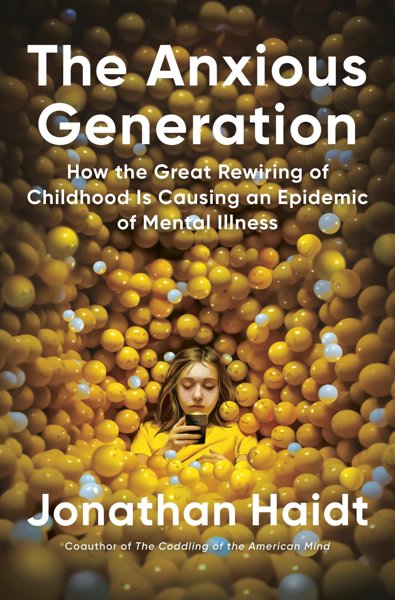
Today: The Anxious Generation, by Jonathan Haidt.
Haidt says smartphones and social media rewired childhood in the early twenty tens, and set off a wave of anxiety and depression. Parents love this book. Plenty of scientists do not.
My verdict: it’s the clearest, most useful argument for changing how kids grow up that I’ve come across, but it pushes cause harder than the evidence can carry. Treat it as a strong case, not settled science. Four out of five.
What It’s About
It came out in March twenty twenty four from Penguin Press, around four hundred pages, split into four parts. Haidt is a social psychologist at New York University, and he wrote The Coddling of the American Mind with Greg Lukianoff.
The book opens with a thought experiment. A billionaire invites your ten year old to a settlement on Mars, with no real research on radiation or gravity. You would say no. Haidt says that is roughly what we did to Gen Z, the kids born after nineteen ninety five.
For this review I worked through the introduction, the evidence chapters, all four chapters of fixes, and the conclusion. What I say about the content comes from those pages.
The Big Idea
Haidt’s central claim is that two mistakes landed on the same generation. We overprotected kids in the real world, and underprotected them online. From the nineteen eighties, free play shrank, as parents grew afraid of letting children out of sight. Then smartphones arrived.
He calls the shift to a phone based childhood the Great Rewiring, and dates its peak from twenty ten to twenty fifteen. From chapter three he adds the idea of a discover mode, hungry for new things, and a defend mode, on alert for threats. Kids who never take small risks, he argues, get stuck in defend mode.
The timing is his evidence. The like button arrived in two thousand nine, front facing cameras in twenty ten, and Facebook bought Instagram in twenty twelve. Chapter one then shows major depression among American teens rising about one hundred and fifty percent, with similar jumps in the UK, Canada, Australia and the Nordic countries.
The Four Harms
The core of the book is chapter five, which names four foundational harms. I like this chapter because it turns a vague worry into a checklist. Each harm is something you can picture in your own home.
One, social deprivation. For American teens, daily time with friends fell from one hundred and twenty two minutes in twenty twelve to sixty seven minutes in twenty nineteen. Two, sleep deprivation. Three, attention fragmentation, with one study counting about one hundred and ninety two alerts a day on a typical teen’s phone.
Four, addiction. Haidt compares the pull of the apps to slot machines, with dopamine teaching kids to want more. He is careful to say most teens are not clinically addicted, but he argues their attention is being hacked all the same.
Girls, Boys and Meaning
The book then splits by gender. For girls, the heavy users are the story. In one British study, girls with five or more hours of social media on a weekday were three times as likely to be depressed as girls with none. He offers four reasons it hits girls harder, including appearance comparison and relationship aggression.
For boys, he points to video games and pornography, and to young men who drift out of school and work. About seven percent of boys are problematic gamers. Then comes a chapter on spiritual elevation, about awe, ritual and stillness. It is the oddest part of the book, and I will come back to it.
What Works
First, the story. The Mars image sticks, and the argument builds step by step. Each chapter ends with a summary, so even a skimmer follows it. Honestly, that is a big reason it spread so fast.
Second, the play half of the argument. This is the part I think is most underrated. Kids learn by playing unsupervised, taking small risks and getting back up. Even some of Haidt’s critics agree with that.
Third, the idea of a collective action trap. No parent wants their child to be the only one without a phone, so everyone caves. His answer is to act together, with school wide pledges like Wait Until Eighth. That is the most practical insight in the book.
The Four Fixes
Here are the four reforms he calls foundational. No smartphones before high school, so only basic phones until about age fourteen. No social media before sixteen. Phone free schools, where devices stay in lockers or locked pouches all day. And far more unsupervised play and independence.
He also wants governments to raise the age of internet adulthood to sixteen and demand real age checks. He says these steps cost almost nothing, and he believes a community that does all four would see improvement within two years. That is a bold promise, and it is a belief, not a result.
Writing and Pacing
The writing is warm and plain. Haidt explains studies like a professor who wants you to follow, and the charts do a lot of work. It never talks down to you.
But it is long, and it repeats itself. By the fourth time the thesis is restated, you feel it. The middle of part three sags, and the endnotes and references run for pages. The audiobook is just over ten and a half hours, which suits a book you can dip in and out of.
The Scientific Debate
Now the part everyone argues about. Psychologist Candice Odgers reviewed the book in Nature in March twenty twenty four. She wrote that its suggestion of an epidemic caused by rewired brains is not supported by science, and that researchers hunting for big effects have found a mix of no, small and mixed associations.
Andrew Przybylski at Oxford calls the approach vote counting, where the number of studies matters more than their quality. Peter Etchells points to shaky methods, and Christopher Ferguson says there is no solid evidence yet that phone free schools help. The objections come down to three things: correlation is not causation, depressed teens may use phones more, and effects might be small.
Haidt’s Reply
Haidt does answer these, and fairly often in the book. He admits that some findings are contested and that he will be wrong on points. He also argues the small effects came from lumping all screens and all teens together. When he looks at girls and social media, the link is much larger, he says, and he cites dozens of experiments where cutting back helped.
His second argument is about risk. If alarmists are wrong, the cost is some lost phone time. If skeptics are wrong, the cost is far greater. That is a reasonable way to think, even if it is not proof. Both sides do agree on one thing: something real is happening to teen mental health.
Do The Fixes Work?
The fixes are still being tested, and so far the results are mixed. As of October twenty twenty six, a February twenty twenty five study in a Lancet journal of thirty English schools found no difference in student wellbeing between strict phone rules and relaxed ones. It was observational, and total daily use still tracked with worse outcomes.
Australia’s under sixteen social media ban began in December twenty twenty five. The regulator reported that about eighty one percent of under sixteens were still on at least one restricted platform three months in, down from about eighty six. Reporters blame weak age checks. So the fixes are plausible, but unproven.
What Doesn’t Work
First, the subtitle says the rewiring is causing an epidemic, and the evidence is less certain than that verb. Second, the book leans on the studies that support it, and the case for boys is thinner than for girls. Third, the spiritual chapter feels like it belongs to another book.
Fourth, the benefits of phones for some kids, like isolated or autistic teens finding community, get a brief nod and then a quick move on. Finally, the solutions assume parents can coordinate. That is easier in a close school community than in a big city, and the book offers little for families who cannot rely on others.
Content Notes
A quick heads up. The book discusses self harm, suicide, eating disorders, online pornography, and sexual exploitation of minors. It stays at the level of research and parent stories, not graphic detail, but it can be heavy for anyone living with these issues.
The Scorecard
My scores. Argument, four and a half out of five. Evidence, three and a half. Solutions, four. Writing, three and a half. Impact, four and a half. That averages to four out of five.
Evidence loses points for confidence beyond the data. Impact scores high because Reuters reported the book helped push Australia’s law, and few books move a policy debate like that.
Who It’s For
Pick it up if you parent or teach kids between eight and sixteen, or if you want a clear case for delaying phones. It is also good if you like arguments you can push back on. Skip it if you want a neutral literature review, or if you have already followed Haidt’s work closely.
If you like this, try iGen by Jean Twenge, The Coddling of the American Mind, which Haidt co wrote, Stolen Focus by Johann Hari, or The Gardener and the Carpenter by Alison Gopnik. All four are mentioned in the book itself.
Where To Get It
You will find links to the book and audiobook below. I’d love to hear from you. Did your school go phone free, and did anything change? Tell me in the comments.
If you enjoyed this, please subscribe.