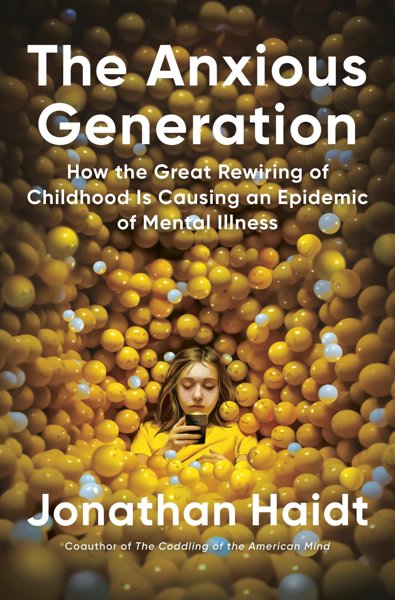
The Anxious Generation by Jonathan Haidt book cover
Non-fiction / Social Science

The Anxious Generation

by Jonathan Haidt

A social psychologist argues that giving kids smartphones and taking away free play rewired childhood in the early twenty tens, and that parents and schools can undo it together.

★★★★☆ 4 / 5

The clearest, most useful argument for changing how kids grow up, with practical fixes and a sharp idea about collective action, but it pushes cause harder than the evidence can carry. Treat it as a strong case, not settled science. Four out of five.

The Anxious Generation: review and fact check

Every guide comes as a video and a full written article. Pick the one you need: the review is spoiler-free, the ending explained is not.

What is The Anxious Generation about?

The Anxious Generation (2024) is Jonathan Haidt’s case that a shift from a play-based childhood to a phone-based one, between about 2010 and 2015, drove a surge in teen anxiety and depression. He names four foundational harms, proposes four reforms, and says families and schools can act together without waiting for lawmakers.

Below you’ll find a spoiler-free review that also covers the scientific debate with critics such as Candice Odgers, my scorecard, and books to read next.

It came out in March twenty twenty four from Penguin Press, around four hundred pages, split into four parts. Haidt is a social psychologist at New York University, and he wrote The Coddling of the American Mind with Greg Lukianoff.

The book opens with a thought experiment. A billionaire invites your ten year old to a settlement on Mars, with no real research on radiation or gravity. You would say no. Haidt says that is roughly what we did to Gen Z, the kids born after nineteen ninety five.

For this review I worked through the introduction, the evidence chapters, all four chapters of fixes, and the conclusion. What I say about the content comes from those pages.

Read it if
  • You parent or teach kids between eight and sixteen
  • You want a clear case for delaying phones and social media
  • You like an argument you can push back on
Skip it if
  • You want a neutral literature review of the research
  • You have already followed Haidt's work closely

The Anxious Generation review scorecard

Argument
4.5
Evidence
3.5
Solutions
4
Writing
3.5
Impact
4.5
Average4.0 / 5

The Anxious Generation: questions people ask

What is The Anxious Generation about?

It came out in March twenty twenty four from Penguin Press, around four hundred pages, split into four parts. Haidt is a social psychologist at New York University, and he wrote The Coddling of the American Mind with Greg Lukianoff.

Is The Anxious Generation worth reading?

The clearest, most useful argument for changing how kids grow up, with practical fixes and a sharp idea about collective action, but it pushes cause harder than the evidence can carry. Treat it as a strong case, not settled science. Four out of five. Read it if: you parent or teach kids between eight and sixteen; you want a clear case for delaying phones and social media; you like an argument you can push back on. Skip it if: you want a neutral literature review of the research; you have already followed haidt's work closely. Review: The Anxious Generation →

What books are like The Anxious Generation?

iGen by Jean M. Twenge, The Coddling of the American Mind by Greg Lukianoff and Jonathan Haidt, Stolen Focus by Johann Hari, The Gardener and the Carpenter by Alison Gopnik.

What is The Anxious Generation about?

Jonathan Haidt argues that a shift from a play-based childhood to a phone-based childhood between about 2010 and 2015, which he calls the Great Rewiring, is the main cause of a rise in adolescent anxiety and depression. He names four foundational harms: social deprivation, sleep deprivation, attention fragmentation and addiction.

What are the four reforms Haidt recommends?

No smartphones before high school (basic phones only), no social media before 16, phone-free schools, and far more unsupervised play and independence. He also asks governments to raise the age of internet adulthood to 16.

Is The Anxious Generation backed by the science?

It is disputed. Haidt cites correlational, longitudinal and experimental studies. Critics such as psychologist Candice Odgers, who reviewed the book in Nature in March 2024, say the evidence for a large causal effect is weaker than the book suggests. Both sides agree teen mental health has worsened (as of October 2026).

When was The Anxious Generation published and how well has it sold?

Penguin Press published it on March 26, 2024. The publisher's page describes it as a number one New York Times bestseller with over two million copies sold, and Wikipedia reports 111 consecutive weeks on the Times nonfiction list as of June 2026 (reported, not independently confirmed).

Books mentioned in these videos

iGen
Jean M. Twenge
iGen book · iGen audiobook
The Coddling of the American Mind
Greg Lukianoff and Jonathan Haidt
The Coddling of the American Mind book · The Coddling of the American Mind audiobook
Stolen Focus
Johann Hari
Stolen Focus book · Stolen Focus audiobook

Amazon links. We may earn a commission if you buy through them.

Related books explained