The Short Version
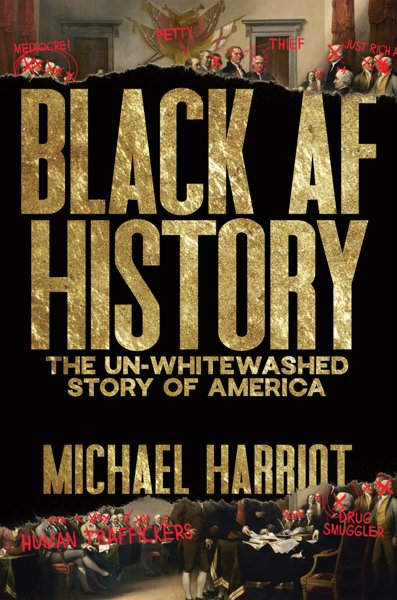
Michael Harriot’s Black AF History: The Un-Whitewashed Story of America, published in 2023, retells American history from the first Africans in the Americas to the present day with Black people at the center. It suits a book club because it is funny, furious and openly a polemic, so members will disagree about its tone, its sourcing and its claims.
Below are fourteen discussion questions plus a section on applying the book, and a short fact-check section so the group can test the stories. The book scores four out of five in our review.
Discussion Questions
- Harriot grew up in Hartsville, South Carolina, and says his education came from the middle room, a den in his grandparents’ house lined with books. How does that frame shape the way he tells history?
- The introduction uses the stolen goose down jacket: the usual version of history is the coat, and his book is the sleeves. Does the metaphor work for you?
- Chapter one argues the English at Jamestown were not heroic builders. They ran out of food, depended on the Powhatan people and, during the starving time, some resorted to cannibalism. What did you learn that school skipped?
- He treats the arrival of the White Lion in August 1619 with twenty and odd Africans as the real beginning of America’s success. Do you accept that framing?
- Harriot argues American slavery was different from older forms because it was based on color, passed down to children and written into law. How persuasive is that case?
- Juan Garrido, Esteban, Queen Nzinga, Onesimus and Jemmy are people left out of the usual story. Which one surprised you most?
- The book’s core argument is that resistance, not suffering, is the main story of Black America, from the Stono Rebellion to freedom suits in Massachusetts courts. Does it change how you read the period?
- Racist Baby, a toddler who asks questions about the Confederacy and reparations, is a device for explaining hard topics simply. Did it work or distract?
- Robert Smalls stole a Confederate ship and sailed it to freedom, and Harriet Tubman led the raid on the Combahee River. Why are stories like these so often missing from classrooms?
- The family stories, including the missing sleeves, his grandmother guarding the porch door with a pistol and the letter to his cousin in prison, connect big ideas to an ordinary family. Which one landed hardest?
- Our review says the tone is relentlessly sarcastic and generalizes about white people constantly, which Harriot says is deliberate. Does it strengthen or undermine his argument?
- There are no traditional citations in the main text, only endnotes and a playful section called Works Not Cited. How much does that matter for a history book?
- Our review says the later chapters on modern politics read more like an opinion column than history. Which chapters felt strongest and which felt weakest?
- Harriot openly says history is always written from a point of view and chooses his own. Is an openly partisan history more or less honest than one that claims to be neutral?
Applying It Together
Ask each member to name one story from the book they had never heard and to look up one more source on it before the meeting. Then compare notes: where did the sources agree with Harriot, and where did they add caution? Close by asking what your own school or community history left out, and what one local source you could read to fill the gap.
What Is True And What Is Stretched
Our fact check tested eight stories. Five were true, one was mostly true and two were exaggerated or debated. Jamestown’s starving time is true, and in 2013 Smithsonian researchers announced cut marks on the bones of a fourteen-year-old English girl nicknamed Jane. The White Lion arrival in 1619 matches colonial records. Onesimus taught Cotton Mather about inoculation, and in the Boston epidemic of 1721 Dr. Zabdiel Boylston inoculated a little over two hundred and forty people, and only six died. Haiti was made to pay France in 1825, with the demand later reduced to ninety million francs. The claims about Sister Rosetta Tharpe inventing rock and roll and Charlie Case as the first stand-up comedian are better treated as debated. Where Harriot stretches, it is in words like first, invented and everyone.
What To Read Next
If your group wants to decide first, start with our review. Our summary covers the whole book, our fact check goes through the surprising stories, and our books-like-it list covers six picks including Stamped from the Beginning, How the Word Is Passed and Lies My Teacher Told Me.