The Short Version
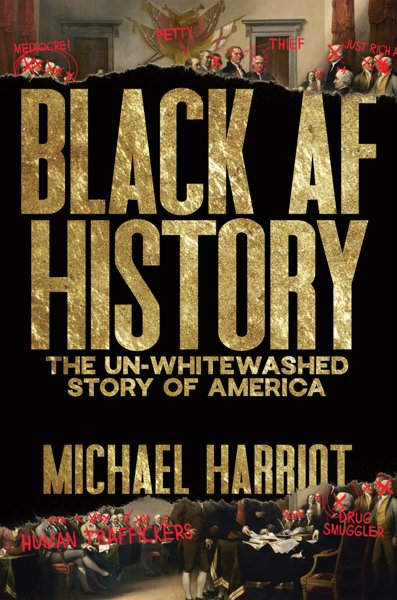
Today I’m summarizing one of the most talked about history books of the last few years: Black AF History, by Michael Harriot, from twenty twenty three.
Here’s the book in one sentence. It retells American history with Black people at the center instead of the margins, and it does it like a stand-up set: angry, funny, and packed with stories most of us never learned in school. Let’s go through the big ideas.
Who Michael Harriot Is
Michael Harriot is a columnist at TheGrio, and before that he was known for his writing at The Root. He grew up in Hartsville, South Carolina, and he was homeschooled for part of his childhood.
His education, he says, came from the middle room: a den in his grandparents’ house lined with shelves of books, where five generations of his family have read, argued and told stories. That room is the lens for the whole book.
The Sleeves
The introduction sets up the metaphor. As a kid, Harriot was mugged for his new goose down jacket, but the thieves couldn’t get the sleeves. Later, a neighbor showed up wearing the coat and swore it was his. The proof that it was stolen? Mikey still had the sleeves.
That’s the book’s mission. The usual version of American history is the coat. Black AF History, he says, is the sleeves: the missing pieces that prove whose story it really is.
Jamestown Was A Mess
Chapter one tears down the founding myth. The English at Jamestown, Harriot argues, were not heroic builders. They picked a swampy site, ran out of food, depended on the Powhatan people, and during the starving time some of them resorted to cannibalism.
What saved the colony was tobacco, and the labor to grow it. In August sixteen nineteen, the White Lion arrived at Point Comfort with twenty and odd Africans, stolen from a Portuguese slave ship. In Harriot’s telling, that is the real beginning of America’s success.
How Slavery Was Built
Chapter two goes back to the fifteenth century. Harriot traces how Portugal’s Prince Henry the Navigator turned kidnapping on the African coast into a business, with the blessing of the Catholic Church, and how the pope later split the world between Portugal and Spain.
His key point is that American slavery was different from older forms. It was based on color, it was passed down to children, and it was written into law. And the idea of a white race, he argues, was invented to justify it.
They Were Here First
The book is full of people left out of the usual story. Juan Garrido, a Black conquistador who landed in Florida with Ponce de León in fifteen thirteen. Esteban, an enslaved African who crossed the American Southwest decades before Jamestown. And Queen Nzinga of Ndongo, who fought the Portuguese for decades.
There’s Onesimus, the enslaved man who taught Cotton Mather about smallpox inoculation, and Jemmy, who led the Stono Rebellion in South Carolina in seventeen thirty nine.
Resistance Was Constant
A huge theme is that enslaved people never stopped fighting back. Harriot covers runaways, maroon communities in the swamps, the Haitian Revolution, and the eighteen eleven German Coast uprising in Louisiana.
He also covers how Black Americans freed themselves during the Civil War, like Robert Smalls, who stole a Confederate ship and later served in Congress, and Harriet Tubman’s raid on the Combahee River.
Reconstruction And Its Destruction
The Reconstruction chapter is one of the strongest. Harriot argues that after emancipation, Black Southerners built schools, churches, businesses and governments almost overnight, and that public education in the South grew out of that era.
Then came the backlash: the Klan, lynching, the end of federal protection, and events like the Wilmington coup of eighteen ninety eight, when a white mob overthrew an elected, multiracial city government.
Women, Culture And The Movement
Later chapters argue that Black women started the civil rights movement long before nineteen fifty five: Ida B. Wells, Mary Church Terrell, and Mary McLeod Bethune, whose lobbying helped create the Tuskegee Airmen.
There are short pieces on culture too: Sister Rosetta Tharpe as the godmother of rock and roll, Charlie Case as an early stand-up comedian, and even recipes, like his aunt’s fried chicken.
The Present Day
The final chapters come up to now: the FBI’s surveillance of Black activists through COINTELPRO, armed self-defense, mass incarceration, the case for reparations, and how the two political parties swapped their positions on race.
He ends with homework, and with a line from his childhood: whatever progress America claims, Black Americans were doing it first.
Is It Worth Reading?
The style is the point. Every chapter mixes family stories, jokes and history, and each one ends with a mock quiz called Three Little Questions. If you like history told with attitude, it’s a blast.
It’s also a polemic, not a neutral textbook, and some readers will find the tone too harsh. My full review goes into that. Tell me in the comments: which story here had you never heard before?