The Short Version
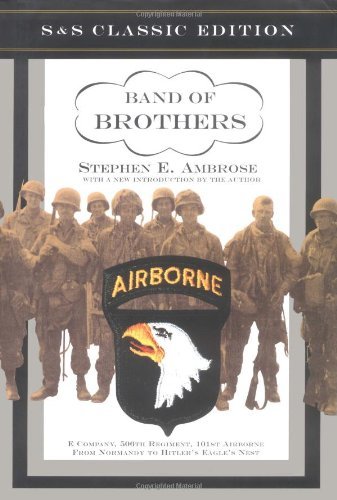
Stephen E. Ambrose’s Band of Brothers, published in 1992, follows Easy Company of the 506th Parachute Infantry Regiment, 101st Airborne, from training in Georgia in 1942 to Hitler’s mountain retreat in 1945. It works well for a book club because it is true, human and told mostly in the veterans’ own words, which invites arguments about leadership, fear and memory.
Below are fourteen discussion questions plus a section on applying the book to your own group. A short section on the HBO series gives members a way to compare. The book scores four out of five in our review.
Before You Start: Content Notes For Your Group
This is a war book. It includes graphic combat, death, the killing of prisoners, a concentration camp and a lot of soldiers’ language.
Discussion Questions
- Ambrose built the book mostly from interviews and letters recorded around 1990, when the men were in their late sixties, and sent the manuscript to the veterans, with Dick Winters and Carwood Lipton reading it line by line. How much should we trust a history built on memory?
- The men were volunteers for a new idea, paratroopers, and many grew up poor in the Depression. Of more than five thousand enlisted volunteers for the regiment, only about eighteen hundred made it through Camp Toccoa. What does that tell you about who they were?
- Captain Herbert Sobel was harsh and petty and made the men incredibly fit, but he was bad in the field. In England his sergeants handed in their stripes. Was the revolt justified, and did Sobel deserve more credit?
- Dick Winters becomes the heart of the company, and the book spends time on Carwood Lipton holding things together. What kind of leadership did each man show?
- On D-Day the planes flew too low and too fast and the men landed scattered, yet Winters and about a dozen men attacked four German cannon at Brecourt Manor. What made that attack work?
- Easy Company spent seventy-eight days on the line in Holland after Operation Market Garden failed. Why does the book give so little drama to a long, grinding defense, and did you want more?
- At Bastogne they were rushed in with no winter clothing and too little ammunition, surrounded, in frozen foxholes under treetop shell bursts. Which detail has stayed with you?
- Ambrose gives a whole chapter to breaking down. Lieutenant Dike froze at Foy and Winters sent in Ronald Speirs, whose fearsome rumors the book never confirms. How does the book treat men who crack?
- Ambrose writes about looting, drinking, breakdowns and officers who froze alongside the heroics. Did that honesty make the heroes more or less admirable?
- Near Landsberg they find a concentration camp, part of the Dachau system, and Winters later wrote that seeing the prisoners made him understand why he was there. How did the book handle that moment?
- Our review notes that other units, especially from the Third Infantry Division, still dispute who reached Berchtesgaden first. How should we weigh a unit’s own account against other claims?
- Our review says Ambrose’s admiration for these fine young men sometimes gets in the way of analysis. Did you notice it?
- The book ends with ordinary lives: farmers, teachers, businessmen and builders. Forty-eight men of Easy Company died in the war. Why do you think Ambrose ends on the peace and not the war?
- Our review says the cast is so crowded that replacements blur together. Which men did you remember, and which did you lose track of?
Applying It Together
Take the leadership question home. Name a leader you have worked under who resembled Sobel, Winters or Lipton, and say what you learned from them. Ask each member which scene they think shows the bond the men kept: they kept writing to each other, met at reunions and nearly fifty years later told their story to Ambrose. If you want a project, decide as a group what kind of history you trust more, a memory-based account like this one or a critical, scholarly one.
The Book And The HBO Series
Your group may want to compare. The HBO miniseries premiered in September 2001, nine years after the book, with ten episodes and Steven Spielberg and Tom Hanks as executive producers. It follows the book almost chapter by chapter, with episodes such as Currahee, Day of Days, Carentan, Replacements, Crossroads, The Breaking Point, The Last Patrol, Why We Fight and Points. It famously says Albert Blithe died in 1948, but records show he recovered, served again, including in Korea, and died in 1967. The book makes no such claim.
What To Read Next
If your group wants to decide first, start with our spoiler-free review. Our full summary covers Easy Company’s war, our book versus series comparison goes through what changed, and our books-like-it list covers six World War Two titles including Beyond Band of Brothers, Citizen Soldiers and With the Old Breed.