The Verdict
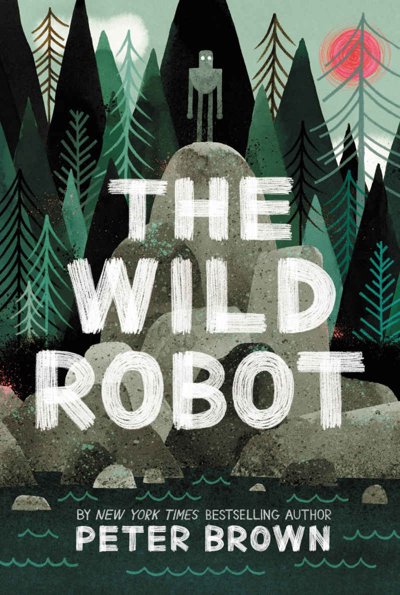
Today’s book is a children’s novel that made a lot of grown-ups cry at the movies: The Wild Robot by Peter Brown.
My verdict: it’s a gem. It’s short, gentle and funny, with some of the loveliest chapters about nature and family I’ve read in a children’s book. It’s best for ages eight to twelve, and it’s a wonderful read-aloud. Adults might find the style simple, but the ideas are not. I give it four and a half out of five.
What It’s About
A hurricane sinks a cargo ship full of robots. One crate washes up on a wild, rocky island, and the otters playing with it accidentally switch on the robot inside. Her name is Roz.
Roz has no idea where she is or why. She doesn’t know about humans, cities or factories. All she knows is that she wants to survive. So she watches the animals, learns their ways, and slowly becomes something no one expected: a wild robot.
The Book At A Glance
The Wild Robot came out in twenty sixteen. It’s eighty very short chapters, some only a page long, with Peter Brown’s own black and white illustrations throughout. A confident reader can finish it in a few days, and a family can read a few chapters at bedtime.
It’s the first book in a trilogy. The Wild Robot Escapes came out in twenty eighteen, and The Wild Robot Protects in twenty twenty three.
The Opening
The first chapters are clever. Brown tells them partly from the animals’ point of view, so Roz is a terrifying monster who stomps through the forest. Then he switches to Roz, who is calm, curious and very polite.
She learns the hard way. She scrapes her way up the sea cliffs, gets caught in a storm on the mountain, and gets chased by bears. The way she survives is by observing, and that sets up the whole book. Roz isn’t strong because she’s a machine. She’s strong because she learns.
What Works
First, Roz herself. She speaks in flat, formal robot sentences, which makes her funny and sweet at the same time. Watching her slowly learn kindness, humor and even love, while insisting she has no feelings, is the heart of the book.
Second, the nature writing. Brown describes seasons, storms, migrations and winter like a naturalist. Kids learn how beavers build dams, how geese migrate, and how animals survive the cold, without ever feeling taught.
Third, the motherhood story. Through an accident, Roz ends up caring for a gosling named Brightbill. A robot raising a goose sounds like a joke, but it’s handled with real tenderness, and it’s the reason so many readers cry.
And fourth, the short chapters. They make the book easy to read in small doses, and each one ends on a small turn that makes you want just one more.
The Characters
Besides Roz and Brightbill, there’s a small cast of animals who feel like neighbors. Loudwing, the old goose who helps Roz raise her son. Mr. Beaver, the engineer. Chitchat, the squirrel who cannot stop talking. Fink, the sly fox. And Swooper, the owl.
None of them are deeply complex, but they’re vivid, and they change. Animals who once called Roz a monster slowly come to trust her. That change is the real plot of the book.
Themes For Kids And Adults
The Wild Robot is about adapting to a new place. It’s about what makes a family, and whether love has to be built in or can be learned. And it’s quietly about technology and nature, and whether they can live together.
For adults, there’s a deeper question. Is Roz malfunctioning, or is she becoming more herself? The book never fully answers, and that’s what makes it a great book to talk about together.
Writing And Pacing
Brown writes simply, with lots of short sentences and a gentle narrator who sometimes talks directly to you, “reader.” The tone is calm and warm, even in scary moments.
The pacing follows the seasons: spring, summer, a hard winter, and spring again. The middle is slow and cozy, which some kids might find quiet. The last part speeds up a lot.
What Doesn’t Work
Now the honest part. First, the style is very simple. Adults reading alone may find the sentences flat, though that’s partly intentional, because we see the world through a robot.
Second, nature is red in tooth and claw here. Animals die, there’s a hunting truce, and a family of geese is killed in an accident early on. It’s handled gently, but sensitive young readers might be upset.
Third, the ending is exciting but abrupt, and it leans on a sequel. Some readers wish the first book stood more on its own.
Is It Right For Your Kid?
It’s ideal for ages eight to twelve, as a solo read. As a read-aloud, younger kids around six or seven will enjoy it too, with a grown-up nearby for the sad parts.
There’s no bad language and no romance. There are some scary chases and fights near the end. If your child loved the movie, the book is a great next step, and it’s quite different in places.
The Scorecard
My scores. Heart, five out of five. Nature and ideas, five. Characters, four and a half. Plot, four. Prose, four. That works out to four and a half overall.
Where To Go Next
I’ve also made an ending explained video, a book versus movie comparison, and a guide to all three books in order. They’re linked below. Tell me in the comments: did The Wild Robot make you cry?