The Short Version
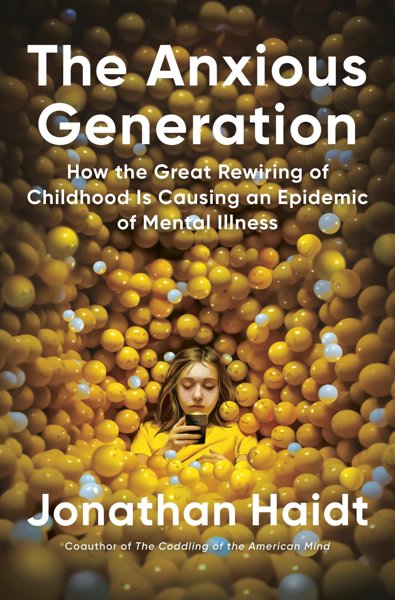
Jonathan Haidt’s The Anxious Generation (2024) argues that a shift from a play-based childhood to a phone-based one, peaking between 2010 and 2015, set off a surge in teen anxiety and depression. He names four foundational harms and four reforms, and says families and schools can act together without waiting for lawmakers. It suits a book club because parents and teachers tend to have strong, personal reactions, and because scientists disagree about how far the evidence goes.
Our review scores it four out of five: the clearest, most useful argument we have seen for changing how kids grow up, but one that pushes cause harder than the evidence can carry. Treat it as a strong case, not settled science. This guide is a set of discussion questions about a book, not medical advice.
Before You Start: Content Notes For Your Group
The book discusses self harm, suicide, eating disorders, online pornography and sexual exploitation of minors. It stays at the level of research and parent stories rather than graphic detail, but it can be heavy for anyone living with these issues.
Discussion Questions
- The book opens with a billionaire inviting your ten-year-old to a settlement on Mars, with no research on radiation or gravity. Does the Mars comparison persuade you, or does it oversimplify what parents actually did?
- Haidt says two mistakes landed on the same generation: kids were overprotected in the real world and underprotected online. Which half of that argument seems more convincing to you?
- He points to the like button in 2009, front-facing cameras in 2010 and Facebook buying Instagram in 2012. Is timing a strong enough clue?
- The four harms are social deprivation, sleep deprivation, attention fragmentation and addiction. Which one do you see most in your own household or classroom?
- American teens went from 122 minutes a day with friends in 2012 to 67 in 2019, according to the book. Does that match what you have seen?
- Haidt separates girls and boys, pointing to social media for girls and to video games and pornography for boys, and admits his story about boys is more speculative. Does the split ring true?
- Chapter three describes a discover mode and a defend mode, and argues that kids who never take small risks get stuck in defend mode. What small risks did you take as a child that kids rarely take now?
- The collective action trap is that no parent wants their child to be the only one without a phone, so everyone caves. Have you felt that pressure?
- The four reforms are no smartphones before high school, no social media before sixteen, phone-free schools and far more unsupervised play. Which would be easiest for your community to adopt, and which hardest?
- Candice Odgers, reviewing the book in Nature, wrote that the suggestion of an epidemic caused by rewired brains is not supported by science. How should a general reader weigh a bold book against a critical scientific review?
- Haidt argues that if alarmists are wrong the cost is some lost phone time, but if skeptics are wrong the cost is far greater. Is that a good way to decide, even without proof?
- A February 2025 study of thirty English schools found no difference in student wellbeing between strict phone rules and relaxed ones, though it was observational. Does that weaken the case for phone-free schools?
- The spiritual elevation chapter is the oddest part of the book, and our review thought it belonged to another book. Did it fit for you?
- Our review says the benefits of phones for some kids, such as isolated or autistic teens finding community, get a brief nod. What would the book lose or gain by giving that more space?
Applying It
Pick one of the four reforms and talk through what it would take in your own family, school or neighborhood, and who else would need to agree. The book’s most practical idea is acting together, for example with a school-wide pledge such as Wait Until Eighth. Then decide how your group would know if it worked, since Haidt himself proposes randomizing whole schools to find out.
What The Evidence Says
Our science page checks the book against its critics. Distress did rise in the data Haidt cites, the four harms are plausible but vary in strength, the claim that social media causes the epidemic is contested, and phone-free schools remain unproven. The dispute over the potato comparison, from Amy Orben and Andrew Przybylski, shows both sides using real studies and disagreeing about what to count. Both sides agree that something real is happening to teen mental health.
What To Read Next
Our review lays out the argument and the scorecard, and our science page covers the debate with critics in detail. The review also suggests iGen by Jean Twenge, The Coddling of the American Mind, Stolen Focus by Johann Hari and The Gardener and the Carpenter by Alison Gopnik.