The Short Version
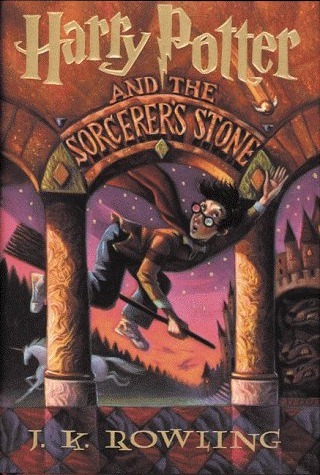
Harry Potter and the Sorcerer’s Stone, J.K. Rowling’s first Harry Potter novel, works well for a book club because it is funny, cozy and built like a detective story, with fair clues that reward a reread. Published in the UK in 1997 as Philosopher’s Stone and retitled by Scholastic in 1998 for the US, it is the shortest book in the series: seventeen chapters, roughly seventy-seven thousand words, around three hundred pages in the US edition.
Below are twenty questions: ten you can use before everyone has finished the book, and ten that spoil the ending. A short section on the 2001 movie gives the group something to compare, especially with HBO’s series arriving at Christmas 2026. The book scores four and a half out of five in our review.
Before You Start: Content Notes For Your Group
This is a book for younger readers, and kids around eight and up can enjoy it. Very young readers may be scared by a three-headed dog, a troll, a hooded figure in a forest and a frightening final confrontation. Our review also notes that the abuse in the Dursley chapters is played for laughs in a way some modern readers find uncomfortable.
Spoiler-Free Questions
- The first chapter starts with Mr. Dursley, who is proud to be perfectly normal, on a day when an owl appears in daylight and a cat reads a map. Why open with him instead of with Harry?
- Harry lives in a cupboard under the stairs, and Hagrid tells him on his eleventh birthday that he is a wizard. How does Rowling balance the cruelty of the Dursleys with their comedy?
- Diagon Alley, the Sorting Hat, moving staircases, chocolate frogs and the Hogwarts Express are all small, specific details. Which one made the world feel real to you?
- Harry, Ron and Hermione do not start as friends: Hermione is annoying, Ron is rude, and it takes a troll in a bathroom to bring them together. Did the friendship feel earned?
- Neville is called the quiet star of the book. What did you notice about him on the first read?
- The book is really a detective story about something valuable hidden in the school. Which suspect did you trust or distrust, and what clues did you follow?
- Snape is described as one of the best written teachers in fiction, because the book lets you hate him for exactly the wrong reasons. Is that fair to the reader?
- Harry sits in front of the Mirror of Erised every night to see his parents. What does the scene say about grief in a book for children?
- The most powerful wizard alive leaves the school on the night it matters, so three eleven-year-olds have to save the day. Is that convincing, or too convenient?
- Our review calls the prose simple and brisk, like a bedtime storyteller. Did you read it aloud, and did it work that way?
Spoiler Questions (Finish The Book First)
- The person after the Stone is not Snape but Professor Quirrell, who carries Voldemort on the back of his head. Did you suspect him, and what were the clues?
- Quirrell says Snape was muttering a countercurse to save Harry and even asked to referee the next match to protect him. Does that change how you read Snape?
- Each obstacle tests a different skill: Fluffy and the flute, Devil’s Snare, flying keys, Ron’s chess game and Snape’s riddle of seven bottles. Which teammate’s moment mattered most?
- Hermione solves the potion puzzle with logic and says there are more important things than books and cleverness, like friendship and bravery. Does the book believe her?
- Only someone who wanted to find the Stone but not use it could take it from the Mirror of Erised. What does that choice say about Harry?
- Quirrell’s hands blister when he touches Harry because Harry’s mother died to save him, and that love left a protection in his skin. Is that a sweet moral or the foundation of the series?
- Nicolas Flamel and his wife choose to let the Stone be destroyed, and Dumbledore says death is the next great adventure for a well-organized mind. How does the book treat death for a young audience?
- Dumbledore gives last-minute House Cup points to Ron, Hermione, Harry and then ten to Neville. Is it a satisfying finish or unfair to Slytherin?
- Hagrid gives Harry a photo album of his parents, and the book ends with a joke about summer with the Dursleys. Why end on such a light note?
- Having finished, which early detail, such as the motorbike, Hagrid’s dragon egg or Harry’s scar, do you now see differently?
Book And Movie
Your group may enjoy comparing the film. The 2001 movie, directed by Chris Columbus and written by Steve Kloves, runs about two and a half hours and stars Daniel Radcliffe, Rupert Grint and Emma Watson. It is one of the most faithful book adaptations ever made, but it cuts Peeves, the troll and Snape’s potion puzzle, shortens the Norbert subplot and trims side characters like Charlie Weasley. In the movie, Hermione’s moment comes in the Devil’s Snare instead of at the potion puzzle.
What To Read Next
If your group wants a spoiler-free read first, start with our review. Our ending explained covers Quirrell, the mirror and Lily’s protection, and it is best saved for after the discussion. Our guide to HBO’s new series is worth a look if your group plans to watch the adaptation together.