The Short Version
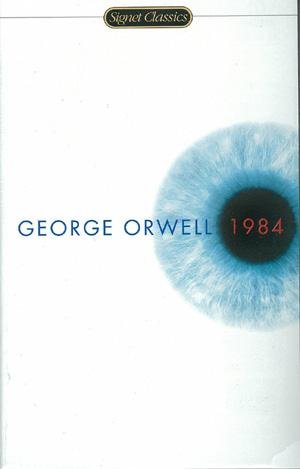
George Orwell’s 1984 suits a book club because it is short, plot-light and packed with ideas that people disagree about: how a government controls the past, what language does to thought, and how much of a person can be taken. Winston Smith rewrites old newspapers at the Ministry of Truth until he buys a notebook and starts a diary, and that one small act drives the whole book.
Below are twenty questions: ten you can use before everyone has finished, and ten that spoil the ending. A short section on the book’s background gives the group something to check. The book scores four and a half out of five in our review.
Before You Start: Content Notes For Your Group
Tell your group first. Part three includes torture and graphic violence, public executions, a hanging described with relish and cruelty involving children. There is sexual content, including joyless or exploitative memories, and the narrator’s attitude toward women is often harsh. Themes include surveillance, suicide and state violence.
Spoiler-Free Questions
- The book opens with the clocks striking thirteen. What does that one detail tell you about the world before anything happens?
- Winston is thirty-nine, frail, a bit vain and has a bad ankle. Why does Orwell make his hero so ordinary, and did it make you root for him more or less?
- Winston’s job is to correct old copies of the Times and drop the originals down a memory hole. Where do you see this kind of quiet rewriting of the record today?
- Syme proudly destroys words for the Newspeak Dictionary. Do you agree that if there is no word for rebellion, rebellion becomes harder to think?
- Doublethink means holding two contradictory beliefs and accepting both. Which slogan stuck with you most: war is peace, freedom is slavery, or ignorance is strength?
- The Parsons children call Winston a thought-criminal, and children are trained to report their parents. How did you react to Orwell’s picture of family life?
- The Two Minutes Hate is contagious even to Winston. Why is shared hatred so effective, and did the scene unsettle you?
- Julia wants to live now while Winston wants to understand. Whose rebellion made more sense to you?
- The glass paperweight, real sugar and a woman singing in the courtyard feel precious because everything else has been drained. Why do small pleasures matter so much here?
- Our review says the middle of the book gets lecture heavy because of the banned book inside the book. Did the theory deepen the story or stop it?
Spoiler Questions (Finish The Book First)
- O’Brien gives Winston everything he hoped for, then turns out to have set the trap. Did you suspect him, and does the betrayal work better because Winston wanted so badly to believe?
- Mr. Charrington, the gentle owner of the junk shop, is a member of the Thought Police, and the telescreen was hidden behind the old print. What did the destruction of the room and the paperweight mean to you?
- O’Brien holds up four fingers and turns up the pain until Winston honestly does not know how many he sees. Is the Party attacking his body or his grip on reality?
- O’Brien says the Party wants power purely for its own sake, a boot stamping on a human face forever. Is that a satisfying answer to why a regime would behave this way?
- O’Brien calls Winston the last man. Do you think Winston’s insistence that he had not betrayed Julia was a real victory or only the last thing the Party had not yet taken?
- Room 101 holds the worst thing in the world for each person, and for Winston it is rats. Why does Orwell make him betray Julia in exactly the way he swore he never would?
- Winston and Julia meet again by chance in the Park and admit they betrayed each other. Why is that scene so quiet, and what does it say about love under the Party?
- The last line is that he loved Big Brother. Was the ending inevitable, or did you hope for something else?
- The Appendix on Newspeak is written in the past tense, as if looking back. What do you make of Orwell ending the book this way?
- Who is most to blame for how the story ends: the Party, O’Brien, Winston himself or the proles who never rise? Make your case.
Where The Book Came From
Your group may want a few facts. 1984 was published in 1949, written in the shadow of the war and of totalitarian states, and Orwell did much of the writing on a remote Scottish island called Jura. The Party’s slogans appear on the front of the Ministry of Truth in the first chapter. Newspeak was meant to replace standard English by about 2050, according to the Appendix. Because Orwell died in 1950, the book has been in the public domain in the UK and the EU since 2021, so free editions exist there. In the United States it was still under copyright as of October 2026.
What To Read Next
If your group wants to decide whether the book is for them, start with our spoiler-free 1984 review. After the discussion, our full chapter-by-chapter summary covers every part, and our books-like-it picks include Brave New World, Fahrenheit 451 and The Handmaid’s Tale, each imagining a different way to lose freedom.