The Short Version
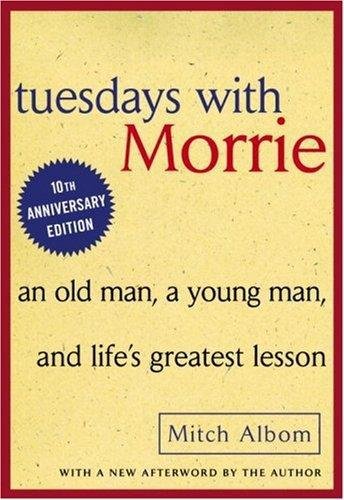
Tuesdays with Morrie, Mitch Albom’s 1997 memoir, is an easy club pick because it is short, about two hundred pages, and every chapter names a topic your group can pick up and argue about. Albom reconnects with his favorite Brandeis professor, Morrie Schwartz, who is dying of ALS, and visits him on fourteen Tuesdays to talk about love, work, family, aging, money and forgiveness.
Below are fourteen discussion questions and an applying-it section. Our review scores the book four out of five, with emotional impact and pacing at four and a half, and notes that it is sentimental and that Morrie is almost too saintly.
Before You Start: Content Notes For Your Group
The subject is terminal illness and grief, so it can be heavy, especially if someone has recently lost a loved one. The book talks plainly about bodily decline and care, there is some mild language, and cancer touches Mitch’s family.
The Real Story
This is a true story. Morrie Schwartz was a Brandeis sociology professor diagnosed with ALS in 1994. He talked with Ted Koppel on Nightline in 1995, which is how Albom found him again. The book says Albom wrote it partly to help pay Morrie’s medical bills. Doubleday published it in August 1997, and it reportedly spent more than two hundred weeks on the New York Times list. The publisher’s 2022 figure is nearly eighteen million copies in about forty-eight languages. Oprah Winfrey’s company made it into a 1999 ABC TV movie with Jack Lemmon as Morrie and Hank Azaria as Mitch.
Discussion Questions
- Sixteen years after graduation, Mitch is a driven Detroit sportswriter juggling five jobs with a cell phone at his ear. Why had he let the promise to stay in touch with Morrie slide?
- On the first visit, Mitch stays in his car finishing a work call while Morrie waits on the lawn. What does that small scene tell you about the book?
- Mitch calls the visits Morrie’s last class: no grades, no textbooks, one student. Which Tuesday topic would you most want to sit in on?
- Morrie throws himself a living funeral so his friends can say kind things while he can still hear them. Would you want one, and who would speak?
- Each morning Morrie lets himself cry about what he has lost, then stops and turns to the people still in his life. Is a daily limit on self-pity wise or too tidy?
- Morrie tells Ted Koppel to his face that he once thought the host was a narcissist. What does his candor say about how he faces death?
- Morrie says to devote yourself to loving others and to your community, and that if the culture does not work, do not buy it. Build your own. How would that look in your life?
- Morrie borrows the Buddhist image of a little bird on your shoulder that asks each day whether you are ready. Try answering it for today.
- The book is blunt about the body: helpers, a bell by his chair, small indignities. Did the practical details deepen the story for you?
- Mitch admits he lied about why he was late and threw away the mail from Brandeis. Did his willingness to show his worst self earn your trust?
- Mitch’s younger brother lives in Spain, fights an illness of his own and keeps the family at a distance. How does that thread echo the main story?
- Our review says Morrie is almost too good and the wisdom is familiar. Is the book’s power in the ideas or in who says them?
- Morrie has family, friends, university support and a team of home aides, and says that without family it would be much harder. Does the book travel to people without that support?
- Albom ends several chapters on a neat lesson and a tear. Did you feel guided or manipulated?
Applying It
Ask your group to answer one question each: who is the Morrie you have lost touch with, and what is stopping you from calling? Then try one of Morrie’s habits this week. Limit self-pity to a short daily window, then turn to the people still around you. Or ask the little bird’s question at the end of the day.
What To Read Next
If your group wants more, our books-like-it list covers six follow-ups. Our spoiler-free review keeps the ending out, so it is safe to read before your meeting.